Zcash NU7 goes live: 3x faster blocks, 12,224 ZEC frozen in Sprout pool
Author: Crypffalo Research · 16:53 06/11/2026
Zcash activated its NU7 upgrade on Nov 6, cutting block time from 75 to 25 seconds and routing 60% of fees to a reserve. About 12,224 ZEC ($15M–$16M) in the legacy Sprout pool is now unspendable.

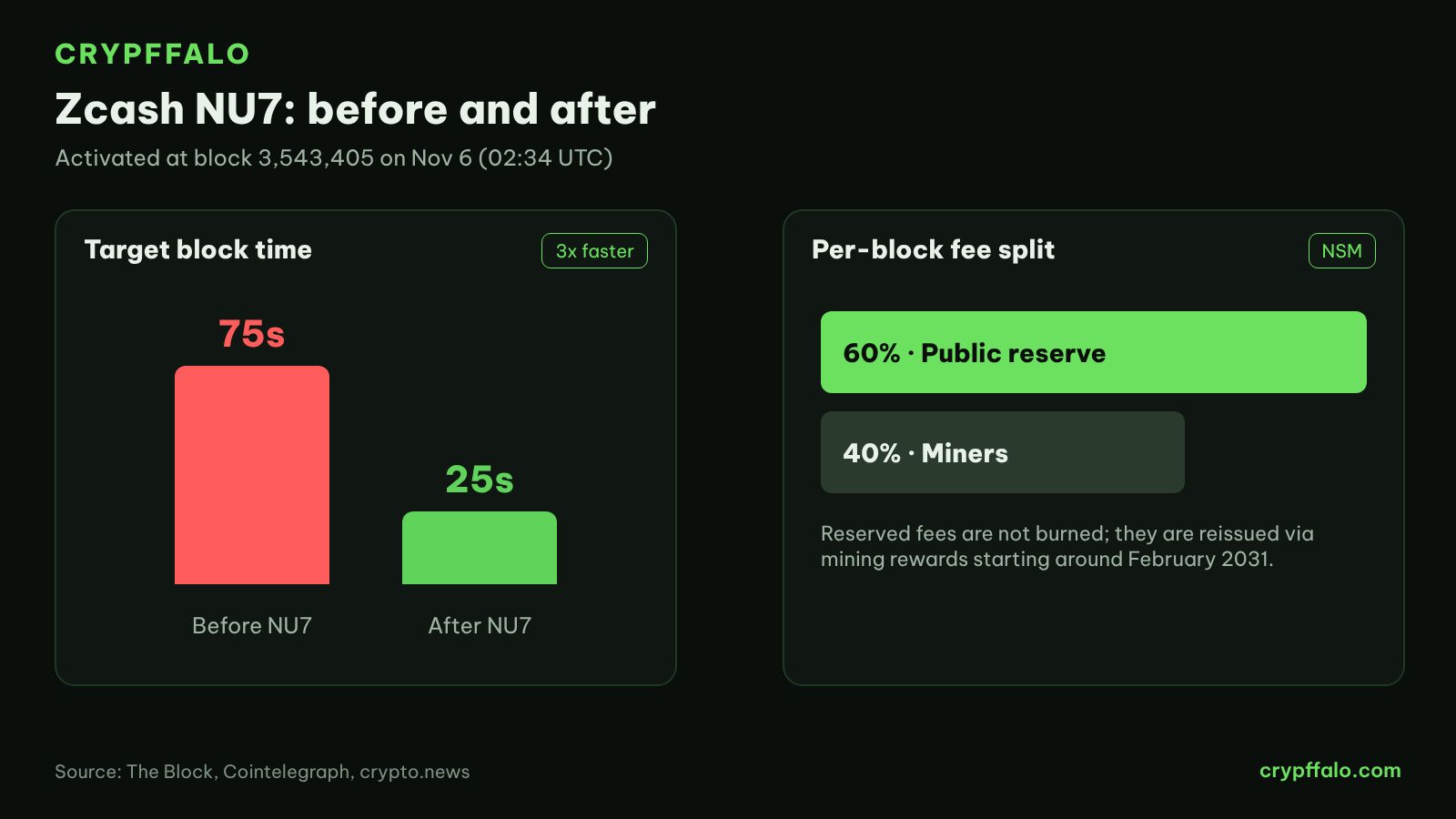
Zcash activated its NU7 network upgrade at block 3,543,405 at around 02:34 UTC on Nov 6 (9:34 a.m. GMT+7). The target block time dropped from 75 seconds to 25 seconds, making the chain three times faster.
The upgrade also carries a contentious side effect. About 12,224 ZEC still sitting in the legacy Sprout shielded pool can no longer be spent, a stash worth roughly $15 million to $16 million at current prices.
Key takeaways
- The event: NU7 went live on Zcash mainnet at block 3,543,405 on Nov 6.
- Speed: Target block time cut from 75 seconds to 25 seconds.
- Fees: 60% of each block's fees now go to a public reserve, with miners keeping 40%.
- Sprout pool: About 12,224 ZEC ($15 million to $16 million) is frozen, not burned.
- ZEC price: Trading near $1,250, down about 5% over 24 hours amid a broad market selloff.
What NU7 changes
The headline change is speed. Blocks now arrive every 25 seconds instead of 75, so transactions get their first confirmation about three times faster.
According to crypto.news, actual block times averaged roughly 39 seconds in the first hours after activation. That figure should drift toward the target as network difficulty adjusts.
To keep faster blocks from inflating supply, the per-block subsidy was scaled down by the same factor. The number of blocks between halvings was tripled, so the issuance curve, halving schedule and 21 million ZEC cap are unchanged.
A new fee model for long-term security
NU7 also switches on the Network Sustainability Mechanism (NSM), built by Shielded Labs. Instead of miners collecting every fee, 60% of each block's fees is removed from circulation and held in a public reserve.
Those fees are not permanently burned. They will be reissued through future mining rewards starting around February 2031, at block 8,939,664 according to The Block.
Shielded Labs argues that Zcash, like Bitcoin, must find a way to fund network security as block rewards shrink. The NSM is its answer to that problem.
Why 12,224 ZEC is stuck
Sprout was Zcash's original shielded pool, launched with the network in 2016. It stopped accepting new deposits years ago, but withdrawals were still possible until NU7.
NU7 disables version 4 transactions, and Sprout is the only pool that still relies on them. As a result, the remaining ZEC in Sprout is frozen rather than destroyed.
The specification leaves room for a future upgrade to restore access. It also warns that spending those funds may never be re-enabled, and no recovery proposal has been approved so far.
Users holding funds in the newer Sapling, Orchard or Ironwood pools through modern wallets do not need to migrate. Sprout addresses start with "zc".
What it means for crypto markets
ZEC is trading near $1,250, down about 5% over the past 24 hours. The drop coincides with a sharp selloff in Bitcoin and US tech stocks, which makes it hard to isolate any NU7 effect.
- Bull case: Faster blocks and the new fee model could make Zcash more competitive for private payments and ease structural sell pressure from miners.
- Risk case: Controversy over the frozen coins could weigh on sentiment, while weak broader markets may keep dragging altcoins lower.
The 12,224 frozen ZEC is a small slice of total supply, so the direct effect on circulating supply is limited.
What to watch next
- Whether real block times settle near the 25-second target over the coming days.
- Community and developer response to any proposal to recover Sprout funds.
- Broader market conditions; see our real-time liquidations and economic calendar.
Frequently Asked Questions
Do ZEC holders need to do anything after NU7?
Most users on modern wallets do not. Keeping wallet and node software up to date is enough.
Were the Sprout coins burned?
No, they are frozen, not burned. A future upgrade could restore access, but that is not guaranteed.
Does NU7 increase ZEC inflation?
No. Block subsidies were scaled down accordingly, so the issuance schedule and 21 million cap stay the same.
*This content is for information only and is not financial advice.*
Tags: Zcash, ZEC, NU7, Network Upgrade
Related articles
- Bitcoin ETFs Bleed $430M as BlackRock IBIT Outflow Streak Tops $1 Billion
- Core Scientific to exit Bitcoin mining by year-end as AI colocation hits $215M
- Bitcoin Falls Below $76,000 as Nasdaq Tumbles 4%, Crypto Liquidations Top $1B
- Mercado Bitcoin hack grows to $48.6M as drain ran 4 hours past 'contained' claim
- Trump Media Moves 4,259 BTC ($342M) to Crypto.com Ahead of Nov 30 Debt Put
- Bitcoin Reclaims $80,000 as Over $400 Million Liquidated in One Hour