US Treasury Cuts MEXC Off From US Financial System Over $16B in Illicit Flows
Author: Crypffalo Research · 07:54 07/11/2026
FinCEN barred US financial institutions from processing transfers with MEXC Global, alleging the exchange handled at least $16 billion in illicit transactions tied to Iran, Russia and North Korea between 2021 and 2026.

The US Treasury, through the Financial Crimes Enforcement Network (FinCEN), has moved to cut crypto exchange MEXC Global off from the US financial system. The order was announced on the afternoon of Nov 6 ET, early Nov 7 in GMT+7.
FinCEN alleges MEXC processed at least $16 billion in illicit transactions between May 2021 and May 2026. The flows are tied to sanctions evasion and cybercrime linked to Iran, Russia and North Korea.
Key takeaways
- The order: US financial institutions are barred from processing transfers to or from MEXC Global, effective 30 days after publication in the Federal Register.
- Main allegation: At least $16 billion in illicit transactions over roughly five years.
- Russia link: About $1.5 billion, including dealings with Garantex, Grinex and the A7A5 stablecoin.
- Iran link: About $1 billion with more than 40 Iranian crypto exchanges, plus roughly $22 million tied to Iran's central bank and the IRGC.
- Legal basis: Section 9714 of the Combating Russian Money Laundering Act, not a standard OFAC sanctions designation.
What FinCEN alleges
According to FinCEN, MEXC is incorporated in Seychelles, was founded in 2018 and ranks among the world's roughly 20 largest crypto exchanges. It handles more than $1 billion in daily transactions, lists over 3,000 tokens and held about $5 billion in reserves as of September.
The figures cited in FinCEN's order include:
- About $1.5 billion tied to Russian sanctions evasion, including $232 million directly with entities sanctioned by the US, EU or UK.
- Nearly $200 million linked to the ruble-backed A7A5 stablecoin, and at least $26 million with the A7 network.
- Transactions with Garantex (sanctioned by the US in 2022) and its successor Grinex continuing as late as June 2026.
- About $1 billion sent to or received directly from more than 40 Iranian crypto exchanges.
- Roughly $22 million involving the Central Bank of Iran, the Islamic Revolutionary Guard Corps (IRGC) and its Qods Force.
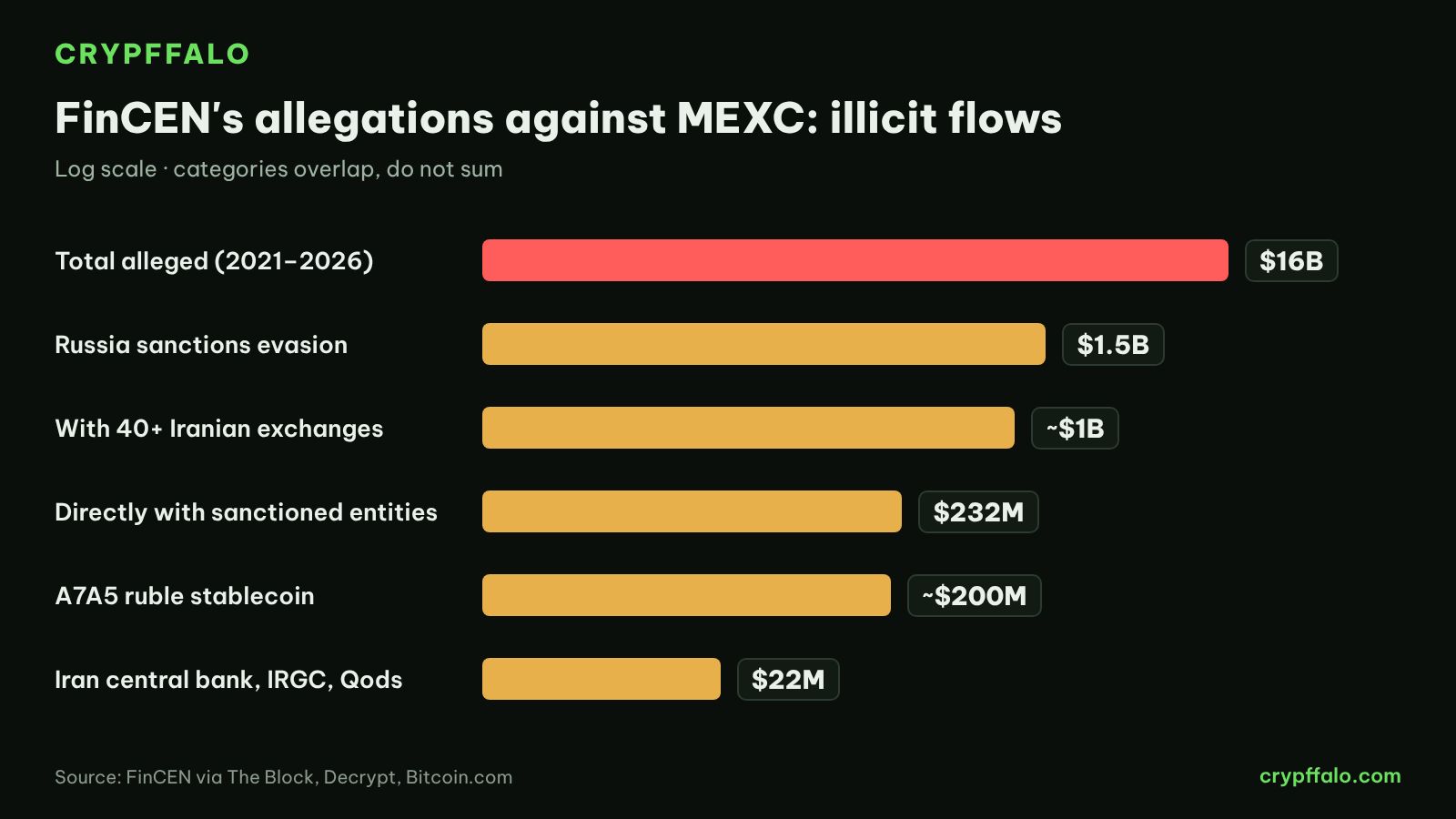
These categories overlap, so they should not be added together. The reports reviewed did not give a separate dollar figure for North Korea-linked activity.
Why Washington chose this tool
The action is part of "Operation Economic Outcast," an effort to isolate Iran from international financial markets. Treasury Secretary Scott Bessent said financial institutions cannot both support the Iranian regime and use the US financial system.
Treasury noted that MEXC claims to run anti-money laundering controls and to block users in places such as Iran and North Korea. It concluded, however, that those controls suffer from "severe deficiencies."
As of writing, major outlets had not reported an official response from MEXC. The exact effective date depends on when the order is published in the Federal Register.
What it means for crypto markets
Markets have shrugged off the news so far. Bitcoin is trading around $75,800 within a 24-hour range of roughly $74,900 to $76,300, while the exchange's MX token slipped about 1.3% to around $1.55.
- Bull case: The 30-day runway gives users and partners time to adjust, limiting the risk of a sudden liquidity shock.
- Risk case: Banks, payment rails and non-US partners may pre-emptively cut ties with MEXC, triggering withdrawals from the exchange and pressure on MX.
The move lands in an already fragile week, with Bitcoin ETFs logging repeated outflows and a string of exchange security incidents. Using a financial cut-off against a top-tier exchange signals rising regulatory risk for offshore venues.
What to watch next
- The Federal Register publication date and the 30-day effective deadline that follows.
- MEXC's official response and on-chain data on outflows from the exchange.
- Reactions from on-ramps, banks and stablecoin issuers that work with MEXC.
- Broader price action; see the economic calendar and real-time liquidations.
Frequently Asked Questions
Are MEXC users outside the US affected right away?
The order targets US financial institutions and does not directly freeze user accounts. If international payment partners cut ties, however, deposits and withdrawals through some channels could be disrupted.
How is this different from OFAC sanctions?
This is a FinCEN order under Section 9714 that bars US financial institutions from dealing with MEXC. It is not an OFAC SDN listing, which directly blocks assets.
When does the order take effect?
It takes effect 30 days after publication in the Federal Register. The publication date has not yet been disclosed by the sources.
*This content is for information only and is not financial advice.*
Tags: MEXC, FinCEN, Regulation, Sanctions, Iran
Related articles
- Fed's Musalem sees several rate hikes by spring 2027 as US retail sales beat forecasts
- Supreme Court rejects Custodia Bank's bid for Fed master account
- Peraire-Bueno brothers acquitted in $25M Ethereum MEV exploit case
- US PPI Hits 6.5%, Highest Since 2022, as Markets Price a December Fed Hike
- Trump Names 4 SEC and CFTC Nominees, First Picks in About a Year
- US October CPI rises 0.4%, above forecasts; Bitcoin slips below $74,000