Supreme Court rejects Custodia Bank's bid for Fed master account
Author: Crypffalo Research · 06:56 17/11/2026
The U.S. Supreme Court declined on Nov 16 to hear Custodia Bank's appeal, leaving the Fed with discretion over master accounts and ending a roughly six-year legal fight.

The U.S. Supreme Court on Monday, Nov 16, declined to hear Custodia Bank's appeal in its long-running fight for a Federal Reserve master account. The case, No. 26-62, was listed under "certiorari denied" on the Court's order list.
The decision leaves in place a Tenth Circuit ruling that Reserve Banks have discretion to grant or deny master accounts, even to eligible institutions. It effectively ends roughly six years of litigation by the Wyoming crypto bank founded by Caitlin Long.
Key takeaways
- Decision: The Supreme Court refused to review Custodia's case against the Fed Board of Governors on Nov 16.
- Legal effect: The ruling that the Fed holds discretion over master accounts stands.
- Case history: Custodia applied in October 2020, was rejected by the Kansas City Fed on Jan 27, 2023, and lost in both lower courts.
- Reaction: Custodia and Long had not commented when the news broke.
- Open door: The Fed is still weighing a slimmed-down payment account for novel institutions.
Why a master account matters for crypto
A master account gives a bank direct access to Fed payment rails such as Fedwire, without relying on a correspondent bank. For crypto firms, it is a way to reduce dependence on partner banks, many of which cut ties with the industry in 2023.
Custodia is a Wyoming special purpose depository institution (SPDI) that makes no loans and holds full reserves. Under Fed guidelines published in August 2022, uninsured firms like Custodia fall into "Tier 3," which receives the strictest review.
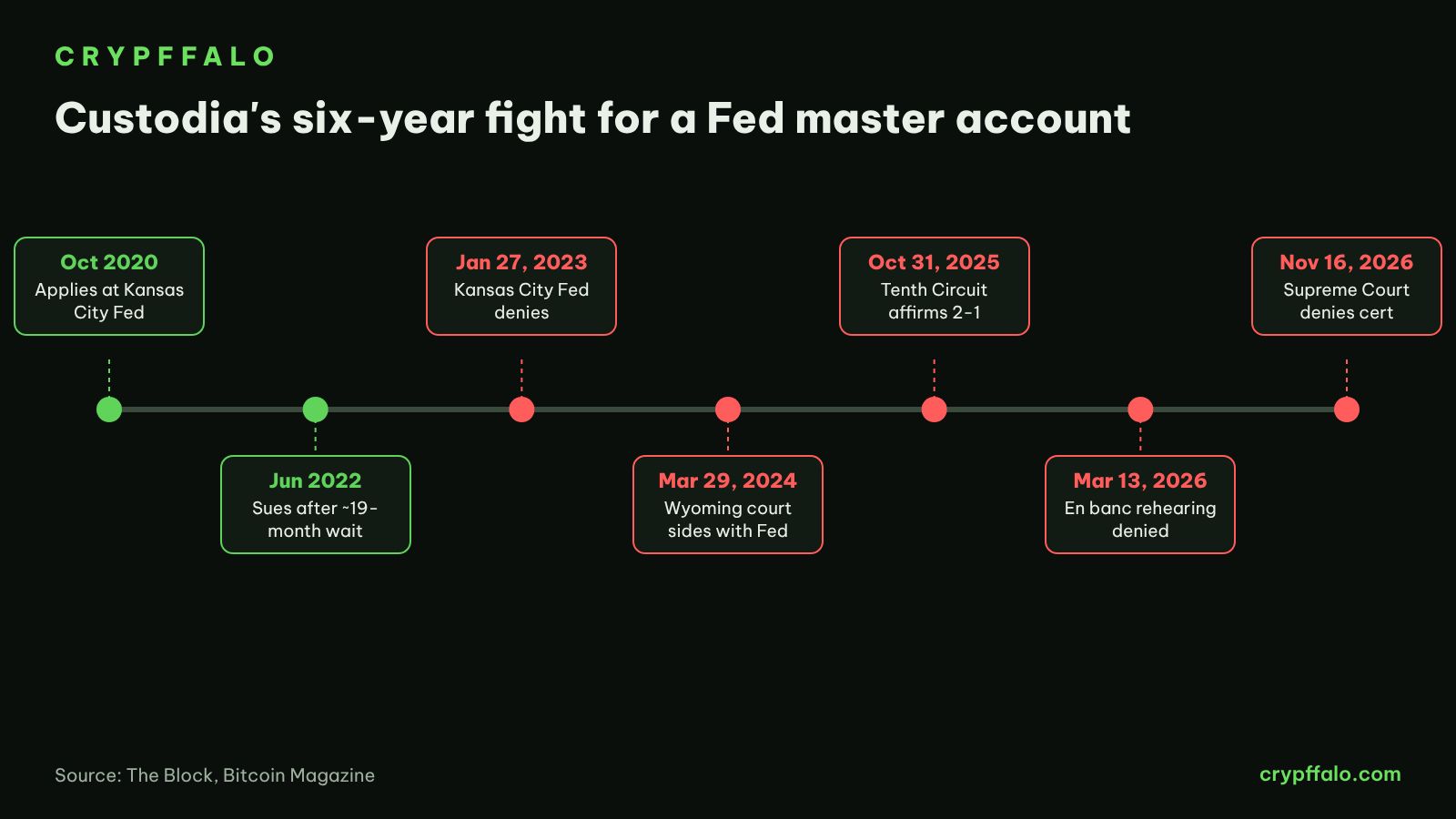
Key dates in the case
- Oct 2020: Custodia applies for a master account at the Kansas City Fed.
- Jun 2022: Custodia sues after its application sits for about 19 months.
- Jan 27, 2023: The Kansas City Fed denies the request, calling the business model "unprecedented" and narrowly focused on crypto.
- Mar 29, 2024: A federal district court in Wyoming rules for the Fed.
- Oct 31, 2025: A Tenth Circuit panel affirms 2-1.
- Mar 13, 2026: The full Tenth Circuit denies rehearing, with three judges voting to rehear.
- Nov 16, 2026: The Supreme Court denies certiorari.
Judge Timothy Tymkovich, who dissented at the appeals court, wrote that being denied a master account is "akin to a death sentence" for a bank. He argued a 1980 law requires the Fed to offer payment services to all nonmember depository institutions.
The wider picture on Fed access
According to The Block, Kraken's banking arm became the first crypto company to obtain a master account in March 2026. That shows the door is not shut, but opening it remains entirely up to the Fed.
Separately, the Fed has sought comment on a slimmed-down payment account, an idea first floated by Governor Christopher Waller. It would pay no interest on balances and offer no discount-window access. Crypto advocates called it "overdue," while community banks warned that new entrants do not face the same compliance regime.
Crypffalo data view
Crypffalo's DeepDom data for the 24 hours to 6:00 a.m. GMT+7 on Nov 17 shows a largely flat market as the news landed:
- Price: BTC at $65,290, up 0.15% over 24 hours → a narrow range.
- Liquidations: $16.4 million in longs versus $30.2 million in shorts → shorts took more of the pain.
- Aggressive flows: Net futures flow of -$193.3 million and net spot flow of +$57.3 million → sellers dominated futures while spot leaned slightly to buyers.
- Order book ±1%: $151.2 million in bids versus $196.7 million in asks → the book tilted toward sellers.
The data fits the view that this ruling is a long-term legal story that has not moved prices in any meaningful way. See also real-time liquidations.
What it means for crypto markets
The decision has no direct bearing on Bitcoin's price, which remains under pressure from tech stocks and fearful sentiment after this month's slide. The impact is structural: crypto banks still depend on the Fed's goodwill for direct access.
- Bull case: The Fed finalizes its slimmed-down payment account, giving firms like Custodia a path to direct access without litigation.
- Risk case: The Fed keeps a strict review stance, leaving crypto firms reliant on a handful of partner banks and exposed to sudden debanking.
For retail investors, the takeaway is that crypto's integration into U.S. banking will run through Fed and congressional rulemaking rather than the courts.
What to watch next
- Any official response from Custodia and Caitlin Long on next steps.
- Progress on the Fed's slimmed-down payment account proposal.
- FOMC minutes and Nvidia earnings this week, both of which are driving market sentiment. Check the economic calendar.
Frequently Asked Questions
What is a Fed master account?
It is an account that lets a bank settle payments directly through the Fed's systems. Without one, an institution must route payments through an intermediary bank.
Does Custodia have any options left?
The court route is largely exhausted after this decision. Its remaining options are to reapply or wait for the slimmed-down payment account the Fed is considering.
Did the ruling push Bitcoin lower?
There was no clear market reaction, with BTC trading flat near $65,000. This is a legal story with long-term implications for the industry's banking infrastructure.
*This content is for information only and is not financial advice.*
Tags: Fed, Regulation, Custodia, Crypto banking
Related articles
- Bitcoin tests $64,000 then slips as Anthropic opens 34% above its record IPO price
- Nvidia beats with $115.8B revenue, but Bitcoin barely moves near $64,500
- Fed's Musalem sees several rate hikes by spring 2027 as US retail sales beat forecasts
- Peraire-Bueno brothers acquitted in $25M Ethereum MEV exploit case
- Bitcoin Breaks Below $64,000, Ether Loses $1,800 as ETF Outflows Top $1 Billion
- US PPI Hits 6.5%, Highest Since 2022, as Markets Price a December Fed Hike