South Korea moves to lift 9-year ICO ban, cap crypto exchange stakes at 20%
Author: Crypffalo Research · 09:53 25/11/2026
South Korea's FSC unveiled a draft bill that would end the 2017 ICO ban, cap major shareholders of crypto exchanges at 20% and limit won stablecoin issuance to bank-majority groups.

South Korea's Financial Services Commission (FSC) on Nov 24 unveiled a draft digital asset bill that would lift the country's ban on initial coin offerings (ICOs), in place since September 2017. If passed, domestic projects could sell tokens to the public for the first time in nearly nine years.
The same draft would cap any major shareholder's stake in a crypto exchange at 20% (up to 34% with FSC approval) and limit won-backed stablecoin issuance to groups majority-owned by banks. The bill is still a draft and must pass the National Assembly.
Key takeaways
- ICOs: The 2017 ban would be lifted, but issuers must file a "digital asset white paper" with the FSC before any token sale.
- Liability: False or missing disclosures could bring civil damages, fines and criminal prosecution, mirroring rules for stock offerings.
- Won stablecoins: Banks must collectively own more than 50% of an issuer, which needs at least 5 billion won (about $3.7 million) in equity and 100% reserves.
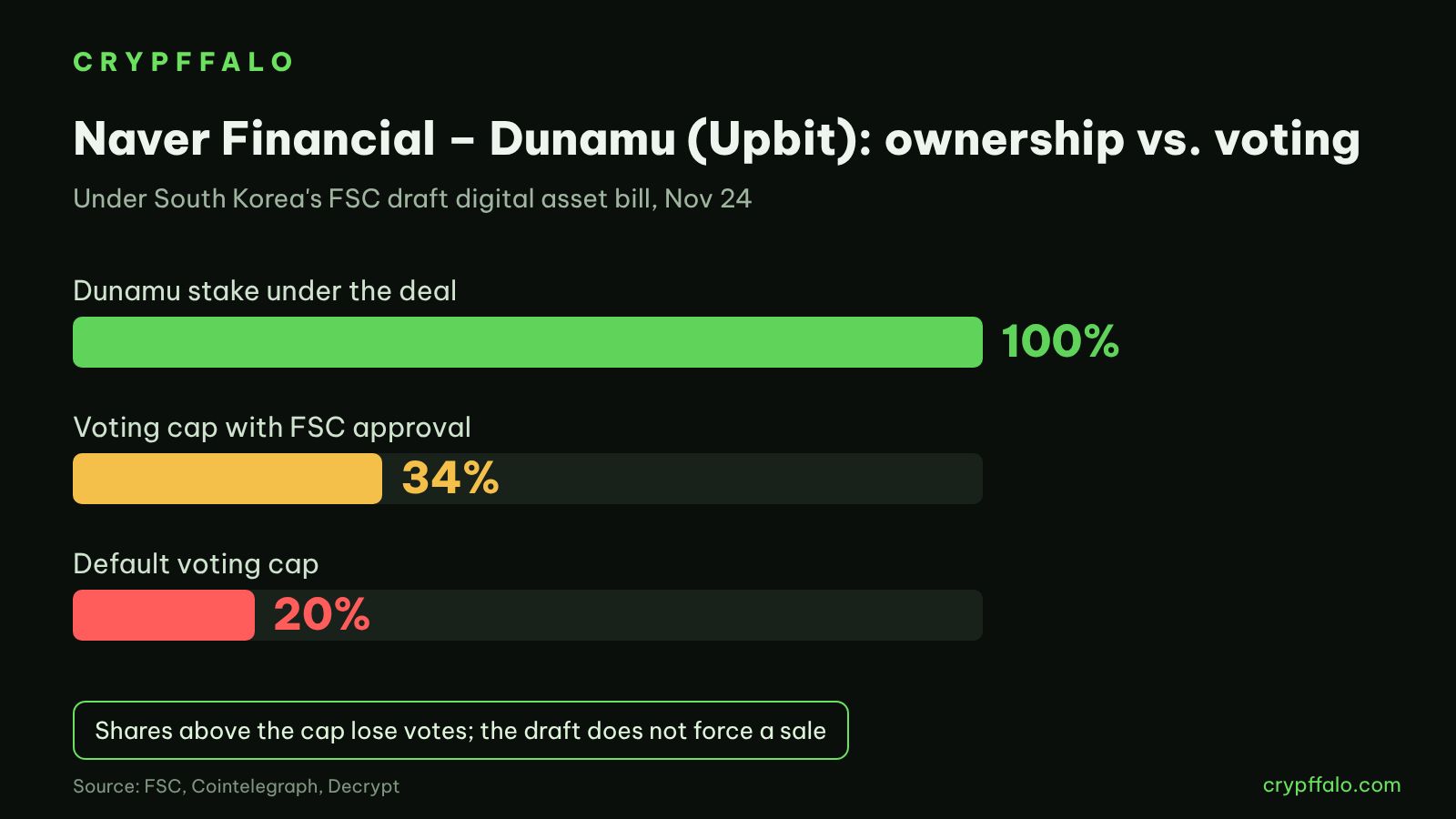
- Exchanges: Major shareholders would be capped at 20%, or 34% with FSC approval; exchanges need dealing, brokerage and custody licenses.
- Timeline: The draft heads to lawmakers, who may merge it with competing proposals, so the effective date is unclear.
ICOs return under IPO-style disclosure
South Korea banned ICOs in September 2017 over fraud, speculation and investor losses. According to Decrypt, regulators now believe the ban never really worked.
Instead, many Korean projects set up entities abroad and ran token sales from there. Game developers Wemade and Netmarble are among the better-known examples. The FSC wants to bring that fundraising, and the investment and jobs tied to it, back onshore.
Under the draft, the white paper filed with the FSC must disclose:
- Details of the project and its issuer.
- How the money raised will be spent.
- The total number of tokens to be issued.
- The risks buyers should understand.
Won stablecoins and the exchange ownership cap
According to Cointelegraph, banks would have to collectively own more than half of any won stablecoin issuer. A fintech or technology company could still be the largest single shareholder.
Issuers would need FSC authorization, at least 5 billion won in capital, and must redeem tokens at face value without delay. The bill stalled for months because the Bank of Korea wanted banks in control, while the FSC had favored opening issuance to nonbank firms.
The 20% cap could directly affect Naver Financial's roughly $11.2 billion deal to buy all of Dunamu, the operator of Upbit. Per Cointelegraph, shares above the cap would lose their voting rights, though the draft does not force a sale.
The draft also extends market manipulation rules to crypto-to-crypto trades. The market would be organized into separately licensed verticals: exchanges, dealing, brokerage, custody and asset management.
Crypffalo data view
Crypffalo's DeepDom data for the 24 hours to 9:00 GMT+7 on Nov 25 shows the broader market still leaning to the sell side, with no visible reaction to the Korean policy news:
- Price: BTC at $59,244, down 2.99% over 24 hours → price stayed below the $60,000 mark.
- Liquidations: Longs liquidated $51.9 million versus $16.2 million in shorts → longs took roughly three times the losses.
- Aggressive flows: Net futures at -$506.2 million and net spot at -$148.7 million → sellers dominated both markets.
- Order book ±1%: Bids at $226.0 million versus asks at $124.8 million → the near-price book leaned to the bid side.
The Korean bill is a long-term story that still needs a vote, so the lack of a short-term flow response is consistent with the nature of the news. See more on DeepDom and real-time liquidations.
What it means for crypto markets
South Korea is one of the world's most active retail crypto markets, so a new legal framework matters for both token projects and exchanges. Still, the near-term price impact is likely limited because the draft has no vote scheduled yet.
- Bull case: Lawmakers pass the bill quickly, giving ICOs and won stablecoins clear licensing, letting Korean projects raise money at home and deepening won-market liquidity.
- Risk case: The ownership cap meets resistance, the bill is merged or heavily amended and delayed, and uncertainty around the Naver–Dunamu deal grows.
The move also fits a wider global shift, including in the US, toward regulated token fundraising.
What to watch next
- The National Assembly's schedule for the bill and any merger with competing proposals.
- Responses from Naver, Dunamu and other major exchanges such as Bithumb to the 20% cap.
- Korean banks announcing consortiums to issue won stablecoins.
- Bitcoin ETF flows and US macro events on the economic calendar.
Frequently Asked Questions
Has South Korea legalized ICOs yet?
No. This is an FSC draft, and the 2017 ban stays in place until the National Assembly passes the bill.
How would the 20% cap affect Upbit?
If the bill passes, Naver Financial could still own all of Dunamu, but shares above 20% (or 34% with approval) would lose voting rights.
Who could issue a won stablecoin?
Under the draft, only FSC-licensed groups in which banks collectively own more than 50% and that hold at least 5 billion won in capital.
*This content is for information only and is not financial advice.*
Tags: South Korea, ICO, Stablecoins, Upbit, Regulation
Related articles
- US Readies Tariff Hikes on 16 Economies; Bitcoin Slips Below $60,000
- New 2027 FOMC Schedule: Fed Drops December, How Bitcoin Reacts
- Asia Selloff: KOSPI Drops 3.3%, Taiwan Bans Short Sales as Bitcoin Rebounds to $61,400
- Sky's USDS sees $1.5B USDC exodus after North Korea-linked flows report
- Fed's Musalem sees several rate hikes by spring 2027 as US retail sales beat forecasts
- Supreme Court rejects Custodia Bank's bid for Fed master account