Asia Selloff: KOSPI Drops 3.3%, Taiwan Bans Short Sales as Bitcoin Rebounds to $61,400
Author: Crypffalo Research · 14:56 23/11/2026
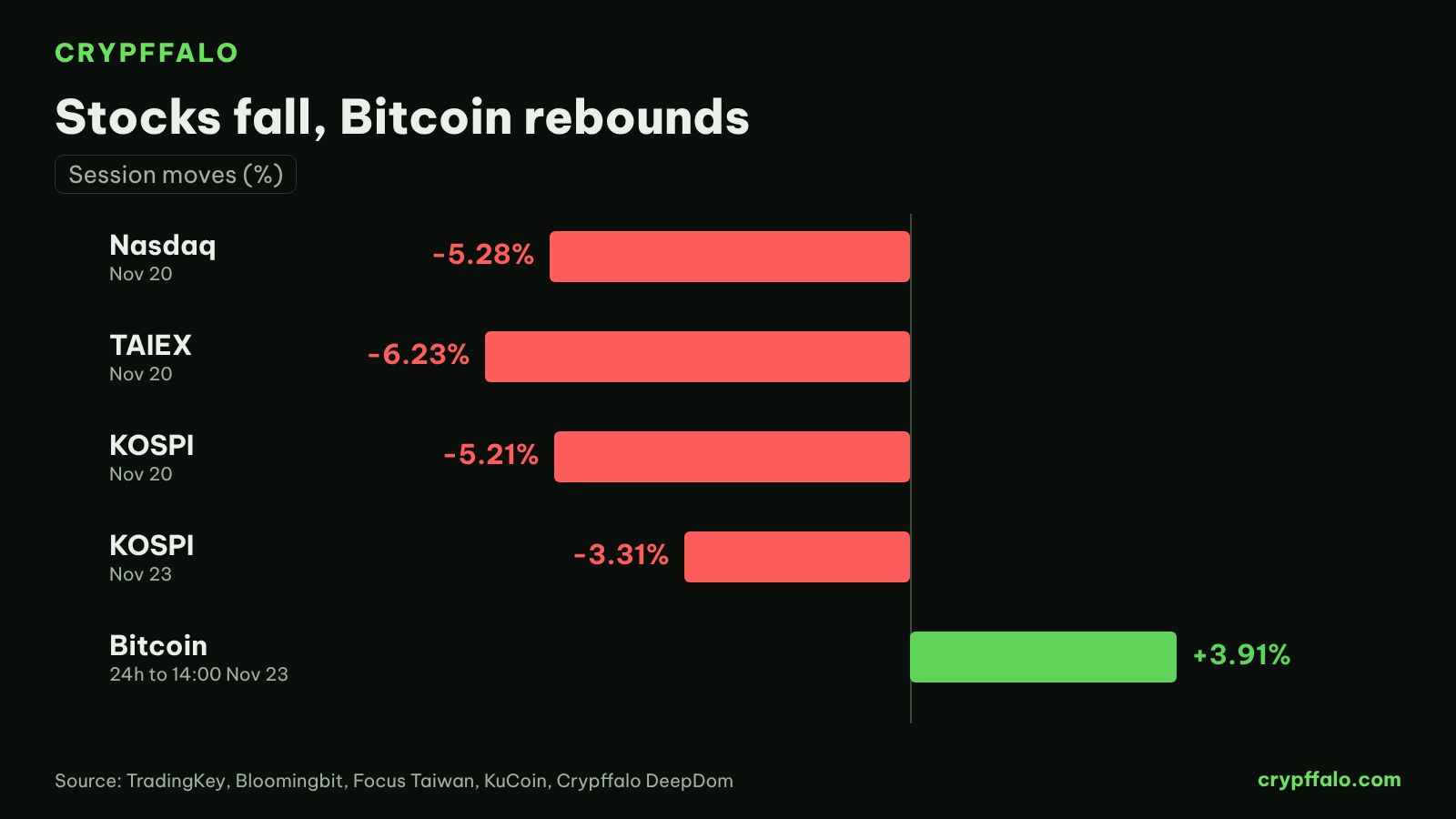
South Korea's KOSPI fell 3.31% on Nov 23 as Seoul readied a stabilization fund, while Taiwan's blanket short-sale ban took effect. Bitcoin moved the other way, up about 3.9% to near $61,400.

Asian stock markets opened the week deep in the red. South Korea's KOSPI closed Nov 23 down 3.31% at 4,708.55, after falling nearly 6% intraday before paring losses.
On the same day, Taiwan's broad short-selling ban took effect following a brutal week for the TAIEX. Bitcoin moved the other way, rebounding to about $61,400 at 14:00 GMT+7, up roughly 3.9% over 24 hours.
Key takeaways
- South Korea: KOSPI fell 3.31% on Nov 23 after a 5.21% drop on Nov 20; Seoul says a market stabilization fund is ready.
- Taiwan: Short sales below the prior close are banned and short-sale margin rises to 150% from 130%, effective Nov 23.
- Trigger: An AI and chip stock selloff spreading from Wall Street, where the Nasdaq lost 5.28% on Nov 20.
- Bitcoin: Back around $61,000–$61,600 after a weekend low near $55,100.
- Caveat: Crypto sentiment remains fragile, with the Fear & Greed Index in extreme fear.
Korean stocks whipsaw as Seoul readies a stabilization fund
The KOSPI opened down 2.77% at 4,734.90 and briefly slipped below 4,500. A "sidecar" was triggered after KOSPI 200 futures fell more than 5%, pausing program trading for five minutes.
Index heavyweights Samsung Electronics and SK Hynix were down around 6% at one point. By the close, Samsung was off 3.06% and SK Hynix 2.52%.
Deputy Prime Minister Lee Hyung-il said the stabilization fund would be deployed if needed, with timing and size to be decided after monitoring. An emergency F4 meeting on Nov 22 had already agreed to:
- Prepare the stock market stabilization fund.
- Ease daily share buyback limits for three months starting Nov 24.
- Step up monitoring of illegal short selling and margin loans.
According to the Seoul Economic Daily, the KOSPI is down about 47% from its peak, reviving calls for a short-selling ban. Foreign investors accounted for about 75% of short-selling turnover between Nov 2 and Nov 20.
Taiwan imposes its first blanket short-sale ban since 2015
Taiwan's Financial Supervisory Commission (FSC) tightened short-selling rules for the third time this month. The new measures took effect Monday, Nov 23, with no end date announced:
- Short sales below the previous session's closing price are banned, covering both margin shorts and borrowed shares.
- The minimum margin for short sales rises from 130% to 150%.
- New put warrant listing applications are suspended.
- Financial institutions are asked to pause securities lending.
The move followed a 6.23% drop in the TAIEX on Nov 20 to 36,033.29. Bloomberg described it as the index's worst week in about 35 years. Taiwan's NT$500 billion (about $15.2 billion) stabilization fund has been buying shares.
Crypffalo data view
Crypffalo's DeepDom data for the 24 hours to 14:00 GMT+7 on Nov 23 shows crypto moving against Asian equities:
- Price: BTC at $61,443, up 3.91% over 24 hours → price recovered while Asian stocks sold off.
- Liquidations: Shorts liquidated reached $54.1 million, more than three times longs at $16.3 million → short sellers took the bigger hit.
- Aggressive flow: Net futures flow was about +$1.01 billion and net spot flow +$121 million → aggressive buyers led in both markets.
- Order book ±1%: Asks of $115.5 million versus bids of $104.0 million → the book tilted slightly toward sellers.
The data diverges from the risk-off picture in Asian stocks: crypto is seeing a short-squeeze bounce, even though resting sell orders near the price still outweigh bids. See also real-time liquidations.
What it means for crypto markets
Bitcoin fell hard alongside tech stocks last week, briefly touching about $55,100. The current rebound comes while Asia is still selling, which tests how tightly the two markets remain linked.
- Bull case: Stabilization steps in Korea and Taiwan calm the selloff, risk appetite improves, and Bitcoin holds the $60,000 area.
- Risk case: Wall Street keeps dumping AI stocks and drags crypto lower; analysts such as Arthur Hayes have warned of a retest of $55,000.
Korean retail investors are active in both stocks and crypto. If equity losses and margin pressure persist, some money on domestic crypto exchanges could be pulled out.
What to watch next
- The US session on Nov 23: whether the Nasdaq and chip stocks recover after last week's steep Wall Street selloff.
- Whether Korea activates its stabilization fund or moves toward a short-selling ban.
- US spot Bitcoin ETF flows, after about $3.47 billion in November outflows.
- The Fed meeting on Dec 8–9; see the economic calendar.
Frequently Asked Questions
Why are Asian stocks falling so sharply?
A selloff in AI and semiconductor stocks spread from the US, hitting chip-heavy markets such as South Korea and Taiwan especially hard.
Does Taiwan's short-selling ban affect crypto directly?
Not directly, since it applies only to equities. It does signal elevated market stress, which tends to weigh on sentiment toward risk assets like crypto.
Where is Bitcoin compared with last week?
Bitcoin was near $61,400 at 14:00 GMT+7 on Nov 23, above its weekend low near $55,100 but still well below early-November levels.
*This content is for information only and is not financial advice.*
Tags: Macro, Asian stocks, Bitcoin, Short selling
Related articles
- US Readies Tariff Hikes on 16 Economies; Bitcoin Slips Below $60,000
- New 2027 FOMC Schedule: Fed Drops December, How Bitcoin Reacts
- Bitcoin ETFs bleed $570M for fifth straight day as BTC slips to $60,600
- Nvidia reinstates Jensen Huang as CEO, shares jump 29%; Bitcoin hits $63,800
- Strategy buys 457 BTC for $29.6M, spends $211.8M on STRC preferred buybacks
- Bitcoin briefly hits $17K on Kraken's CAD market as exchange says trades stand