Solana Activates Alpenglow on Mainnet, Targeting ~150ms Finality
Author: Crypffalo Research · 21:56 21/10/2026
Solana switched to the Alpenglow consensus protocol at epoch 1064 on Oct 21, replacing TowerBFT used since 2020. The upgrade targets transaction finality of about 150 milliseconds, down from several seconds.

Solana activated its Alpenglow consensus upgrade on mainnet around 14:00 UTC on Oct 21, at the start of epoch 1064. It is the network's most significant consensus change since 2020.
According to Anza, the core client team behind Solana's main validator software, the Alpenglow genesis block sits at slot 459,653,000. The upgrade aims to cut transaction finality from roughly 12.8 seconds to about 150 milliseconds.
Key takeaways
- The event: Alpenglow replaces TowerBFT, the consensus mechanism Solana has run since 2020, starting at epoch 1064.
- Speed: Target finality is about 150ms, roughly 40 times faster than before.
- Handoff: Anza said 654 validators took part and the transition took about 900 milliseconds.
- Validator costs: Vote fees are replaced by a 0.8 SOL per-epoch admission ticket, which Anza expects to be about 60% cheaper.
- SOL price: Trading near $107 around activation, with no sharp move so far.
What Alpenglow changes
Until now, Solana validators cast votes as on-chain transactions. Those votes ate up much of the network's capacity, averaging about 3,060 votes per second against about 1,780 user transactions per second (Oct 10–12 data compiled by Solana Compass).
Under Alpenglow, a new voting component called Votor moves voting off-chain. Votes are bundled into certificates that can finalize a block in one or two rounds.
- One round: When at least 80% of stake responds.
- Two rounds: When at least 60% of stake responds, whichever path completes first.
- Fault tolerance: The network keeps running with 20% malicious stake plus another 20% offline.
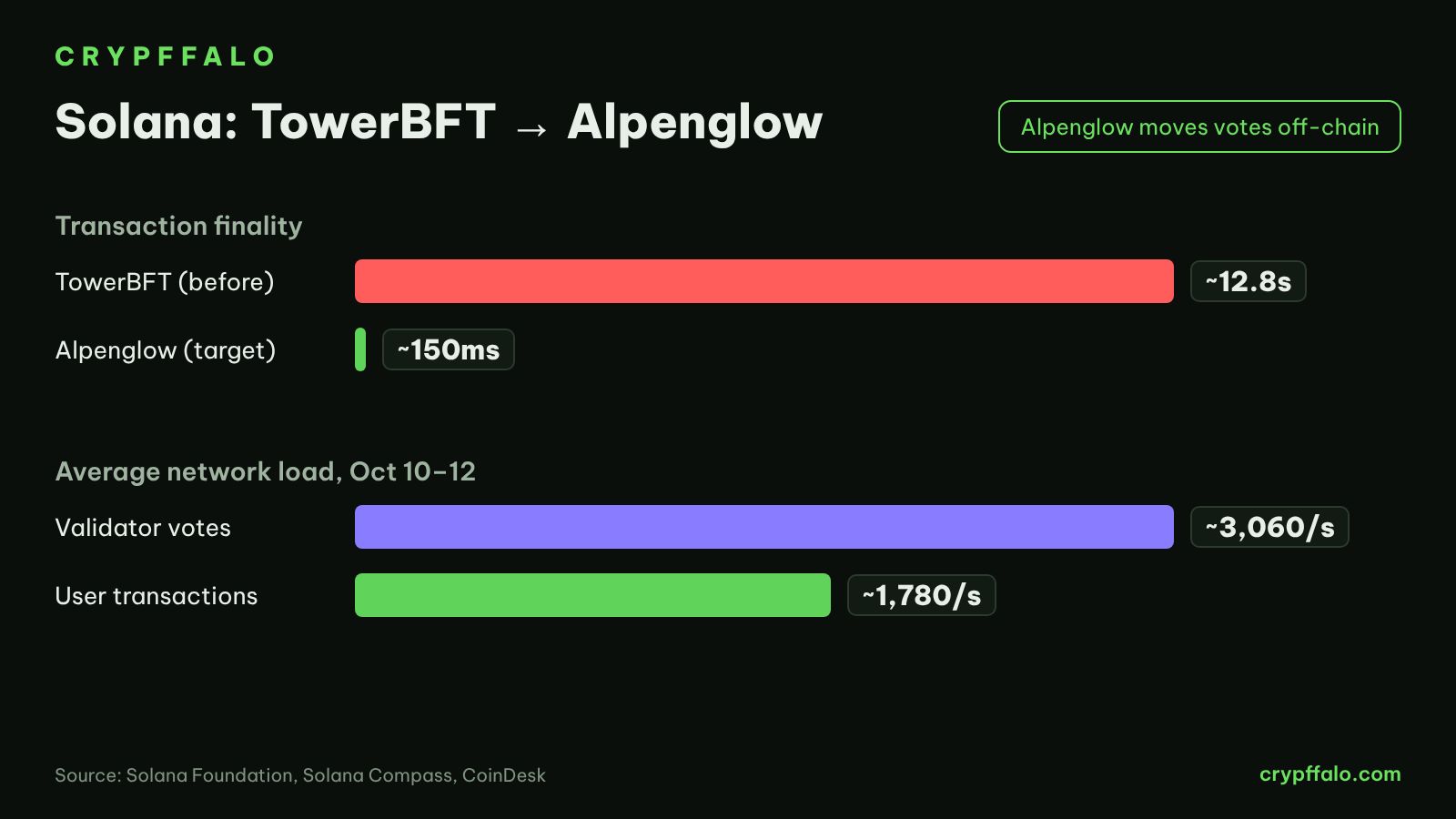
One visible side effect is that Solana's transaction counts will look lower, because validator votes no longer sit inside blocks. That does not mean user activity has dropped.
How the migration works
Anza designed the switch so it could be rolled back safely if anything went wrong. The main steps:
- Feature gate: Turned on at the epoch 1064 boundary, with nothing changing immediately.
- 5,000-slot transition: The network keeps running TowerBFT, after which blocks carry only votes.
- Genesis certificate: Validators holding at least 82% of stake must sign a starting block.
- Handoff: Validators pass consensus to Votor and resume processing user transactions.
Validators approved the proposal in a governance vote in September 2025. On test networks, developers wiped and restarted the network several times since May, including one network-wide migration that failed and was rolled back before a later attempt succeeded.
The second half of Alpenglow, Rotor, a new block propagation layer replacing Turbine, has not yet been scheduled for mainnet. This is only the first stage of the full plan.
What it means for crypto markets
SOL is trading around $107 and has not reacted sharply to the activation. Most details of Alpenglow were public well in advance, so part of the expectation may already be priced in.
- Bull case: A stable network with sub-second finality could draw more payments, high-frequency trading and tokenized asset activity, supporting sentiment around SOL.
- Risk case: Bugs, outages or real-world finality falling short of targets could dent confidence in the network in the short term.
Bitwise's Q3 report, cited by CoinDesk, shows Solana's active validator count fell to 659 at the end of September. Lower voting costs may help smaller validators stay online, though hardware and bandwidth costs remain high.
What to watch next
- Real-world mainnet finality data over the coming days.
- Network stability and further updates from Anza and the Solana Foundation.
- The rollout timeline for Rotor and Firedancer client support for Alpenglow.
- SOL price action and derivatives positioning; see real-time liquidations.
Frequently Asked Questions
Does Alpenglow change how users send SOL?
No. Wallets and transactions work the same way; the change is in how validators reach consensus and how fast transactions are finalized.
Why do Solana transaction counts look lower?
Validator votes used to be counted as on-chain transactions. Alpenglow moves votes off-chain, so total displayed transactions fall while user transactions are unaffected.
Is Alpenglow fully complete?
No. Votor is now live on mainnet, but Rotor, the new data propagation layer, has no rollout date yet.
*This content is for information only and is not financial advice.*
Tags: Solana, SOL, Alpenglow, Network Upgrade
Related articles
- Mt. Gox Delays Bitcoin Repayment Deadline to Oct 2027, 34,400 BTC Still in Wallets
- Bitcoin ETFs pull in $526.7M as BlackRock files for downside-protected BTC ETF
- Strive buys 4,045 BTC for $335 million, lifts Bitcoin holdings to 36,818 BTC
- Strategy buys 267 BTC, spends $193M on STRC buyback, lifts limit to $3B
- JPMorgan Brings JPM Coin Deposit Token to Ethereum Mainnet, Beyond Coinbase's Base
- Google cuts quantum errors 40x on Willow chip, sharpening Bitcoin's quantum risk