Russia to ban P2P crypto trading from July 2027, forcing trades onto licensed platforms
Author: Crypffalo Research · 08:54 16/10/2026
The Bank of Russia confirmed that from July 1, 2027, residents can no longer trade crypto directly with each other; retail buyers face a 300,000-ruble annual cap per licensed intermediary.

Russia's central bank has confirmed that residents will no longer be allowed to trade cryptocurrency directly with each other starting July 1, 2027. After that date, every trade must go through a licensed exchange, broker or digital depository on the regulator's registry.
The rules appear in an updated FAQ on the Bank of Russia's website, reported by Decrypt and The Moscow Times on Oct 15. They implement Federal Law No. 282-FZ on digital currencies, which President Putin signed in August.
Key takeaways
- Deadline: From July 1, 2027, peer-to-peer crypto trades between individuals are removed from the list of legal operations.
- Allowed channels: Only exchanges, brokers, asset managers and digital depositories on the central bank's registry.
- Retail cap: Non-qualified investors can buy up to 300,000 rubles (about $3,600) a year through each intermediary.
- Eligible assets: Bitcoin, Ether and USDT are the assets named for ordinary investors.
- Market: Bitcoin trades near $82,000 with no clear reaction to the news.
What exactly is being banned?
Under the guidance, Russians will not be able to buy or sell crypto directly without a state-regulated intermediary. Third-party P2P marketplaces that simply match buyers and sellers do not count as a compliant channel.
The rules also close several common transfer routes. According to Decrypt, individuals cannot withdraw crypto from a regulated account to their own self-custody wallet.
- Transfers between two individuals through addresses run by a licensed depository are barred, even when both sides agree.
- Ordinary users cannot act as crypto lenders; only brokers, trustees, exchanges and clearing houses can.
- Paying for goods and services with crypto inside Russia remains prohibited.
The guidance does not ban owning a hardware or software wallet. The restriction targets moving assets out of regulated accounts.
Investor limits and the licensed registry
Non-qualified investors must pass a knowledge test and can buy no more than 300,000 rubles a year through each intermediary. Qualified investors also take the test but face no annual cap.
The Bank of Russia is building a registry of authorized crypto operators. Notable names include state lenders Sberbank and VTB.
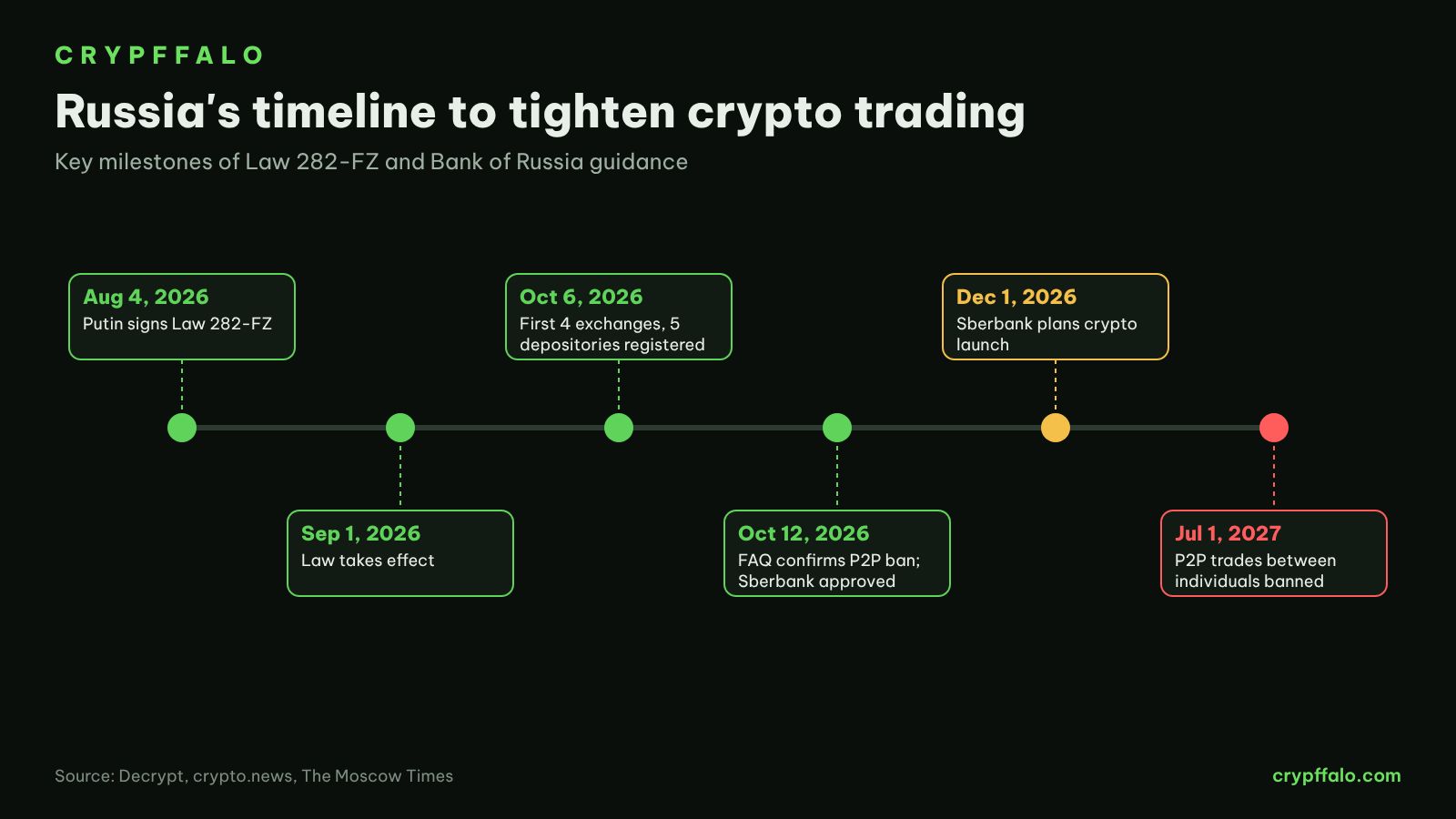
- Oct 6: The first four exchange operators and five digital depositories were registered, including VTB.
- Oct 12: Sberbank received separate approval for exchange services.
- Nov–Dec: VTB plans investor access via its investment platform, followed by its own exchange.
- Dec 1: Sberbank plans to launch its first crypto products with BTC, ETH and USDT.
Exchange operators must be Russian companies with at least 15 million rubles in equity. Firms not yet on the registry can keep operating until July 1, 2027.
Why this matters
Since Binance sold its Russian business to CommEX in 2023, P2P has been a go-to route for Russians buying USDT. Buyers send rubles to a seller's bank card and receive stablecoins in return.
From July 1, 2027, Russian banks must also refuse to fund wallets on foreign platforms, GMT Legal's Andrei Tugarin told Decrypt. Crypto remains allowed for cross-border trade settlements, a carve-out one Russian lawmaker described as a way of "circumventing sanctions."
What it means for crypto markets
The news has not moved prices much, given the deadline is more than eight months away. Bitcoin is holding near $82,000, driven more by hot US inflation data and Fed worries.
- Bull case: Russian P2P flows migrate to licensed rails such as Sberbank and VTB, improving transparency and bringing large banks into the market.
- Risk case: P2P demand for USDT shrinks, some activity moves underground, and other governments may copy limits on self-custody withdrawals.
The Moscow Times noted that some users may try to disguise direct sales as gifts or debt repayments. How strictly the ban is enforced remains an open question.
What to watch next
- Nov–Dec 2026: VTB and Sberbank roll out crypto services to clients.
- New exchanges and depositories added to the Bank of Russia registry.
- How P2P platforms and USDT's issuer respond to the Russian market.
- US macro data next week; check the economic calendar and real-time liquidations.
Frequently Asked Questions
Can Russians still hold Bitcoin in their own wallets?
The guidance does not ban owning hardware or software wallets. However, individuals cannot withdraw crypto from a regulated account to a self-custody wallet.
When does the P2P ban take effect?
On July 1, 2027. Until then, residents can still trade directly under current rules.
How much crypto can ordinary Russian investors buy?
Up to 300,000 rubles a year through each intermediary, after passing a test. Qualified investors have no cap.
*This content is for information only and is not financial advice.*
Tags: Russia, Regulation, P2P, USDT, Bitcoin
Related articles
- Mt. Gox Delays Bitcoin Repayment Deadline to Oct 2027, 34,400 BTC Still in Wallets
- France Votes 31.4% Tax on Crypto-to-Stablecoin Swaps by a Single Vote
- Bitcoin ETFs pull in $526.7M as BlackRock files for downside-protected BTC ETF
- Strive buys 4,045 BTC for $335 million, lifts Bitcoin holdings to 36,818 BTC
- Strategy buys 267 BTC, spends $193M on STRC buyback, lifts limit to $3B
- China Q3 GDP beats forecasts at 4.5%, Bitcoin rebounds to $82,500