OCC Finalizes First GENIUS Act Stablecoin Rule, Leaves Rewards Fight Open
Author: Crypffalo Research · 04:56 22/10/2026
The OCC issued its final rule for payment stablecoin issuers under the GENIUS Act, effective Jan 18, 2027, while dropping a proposed presumption against third-party rewards programs.

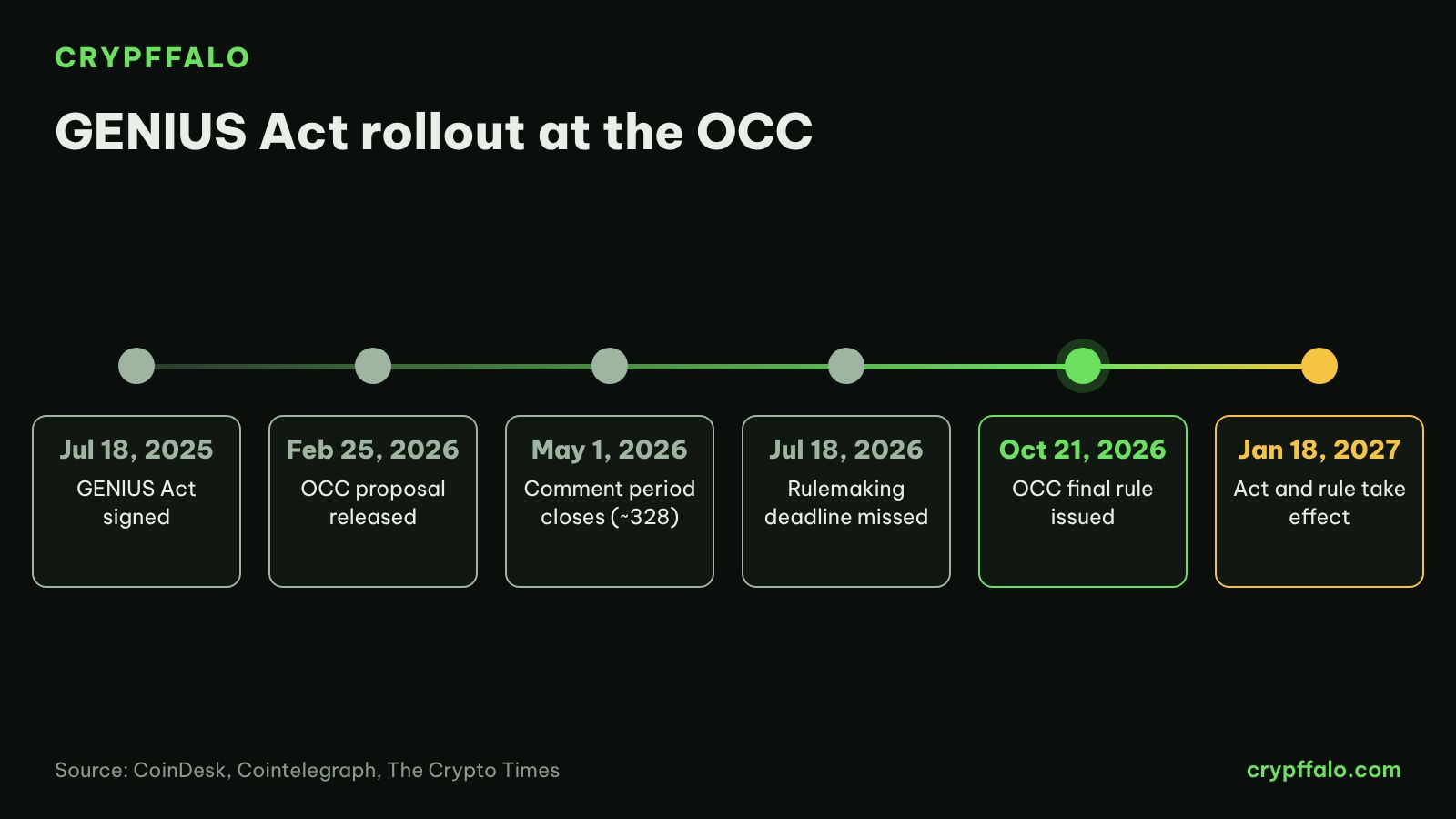
The U.S. Office of the Comptroller of the Currency (OCC) on Oct 21 issued its final rule implementing the GENIUS Act for payment stablecoins. It is the first final rule among the set that several federal agencies must publish before the law can fully function.
The rule and the GENIUS Act both take effect on Jan 18, 2027. From that date, entities issuing stablecoins in the U.S. generally need approval, and unapproved issuance can carry criminal penalties.
Key takeaways
- What happened: The OCC finalized licensing and supervision rules for stablecoin issuers, following a Feb 25 proposal that drew about 328 comments.
- Effective date: Jan 18, 2027, the same day the GENIUS Act kicks in.
- Core requirements: At least 1:1 reserves, redemption generally within two business days, plus capital, audit and custody standards.
- Notable shift: The OCC dropped a proposed presumption that third-party rewards programs violate the law, opting for case-by-case review.
- Still pending: The FDIC, Federal Reserve and Treasury are still working on their own rules.
What the rule requires
The rule covers national banks, federal savings associations, federal branches of foreign banks and nonbank firms seeking federal approval as payment stablecoin issuers. Foreign issuers also fall under its supervision framework.
According to CoinDesk and Cointelegraph, the main provisions include:
- Reserves: Reserves must at least equal outstanding stablecoins, with daily liquidity minimums and limits on single-counterparty concentration.
- Redemption: Holders should generally be able to redeem within two business days.
- Licensing: The OCC will flag whether a filing is complete within 30 days and decide within 120 days after that. The application window has not opened yet.
- Transition waivers: Issuers already operating in the U.S. that apply before Jan 18, 2027 can seek a waiver, capped at 12 months by statute.
The final version is looser than the draft in several places. The OCC scrapped a 20-day weighted-average maturity cap on reserve assets, allowing longer-dated Treasuries, and simplified the capital requirements.
The stablecoin rewards fight isn't over
The GENIUS Act bars issuers from paying interest or yield solely for holding a stablecoin. The OCC's proposal would have presumed that certain rewards paid through affiliates or third parties broke that ban unless issuers proved otherwise.
The final rule removes that presumption and replaces it with a facts-and-circumstances review. At the same time, the OCC declined to presume that programs predating the law are compliant.
That matters for products such as PayPal's 4% on PYUSD, Coinbase One's 3.75% on USDC and Kraken+'s up to 4.5% on USDG. Banks have lobbied against what they call the "stablecoin loophole," fearing deposit flight, and Bitcoin Magazine described the outcome as a setback for the banking lobby.
Treasury Secretary Scott Bessent said the rule provides "a clear, practical foundation" for private-sector innovation. Comptroller Jonathan Gould said the framework sets strong standards for reserve backing, redemption and risk management.
What it means for crypto markets
The rule landed on a day when crypto bounced alongside tech stocks, with Bitcoin climbing to around $84,000 and roughly $188 million in short positions liquidated. The OCC decision was not the main driver of the move, but it is a constructive regulatory signal for the stablecoin sector.
- Bull case: Clearer rules give banks and companies the confidence to issue stablecoins, expanding onchain dollar liquidity and benefiting issuers like Circle and the broader DeFi ecosystem.
- Risk case: Other agencies miss the Jan 18, 2027 start date, or bank lobbying narrows rewards programs, squeezing stablecoin yield products.
The statute required agencies to finish rules within a year, by July 18, 2026, a deadline that was missed. CoinDesk reported that it is unlikely every rule will be final by January.
What to watch next
- When the OCC opens its application window, pending approval of the forms by the Office of Management and Budget (OMB).
- Final rules from the FDIC, the Fed and Treasury, including anti-money-laundering requirements.
- Progress on the CLARITY market-structure bill, where the rewards question could be revisited.
- The Jan 18, 2027 effective date. See our economic calendar and real-time liquidations.
Frequently Asked Questions
What is the OCC?
The OCC is a bureau of the U.S. Treasury that charters and supervises national banks. Under the GENIUS Act, it also oversees many federally regulated stablecoin issuers.
Can stablecoin holders still earn rewards?
Issuers cannot pay yield just for holding a stablecoin. Rewards offered through third parties will be reviewed case by case rather than banned by default.
When does the rule take effect?
The rule takes effect on Jan 18, 2027, the same day the GENIUS Act becomes effective.
*This content is for information only and is not financial advice.*
Tags: Stablecoin, GENIUS Act, OCC, Regulation
Related articles
- France Votes 31.4% Tax on Crypto-to-Stablecoin Swaps by a Single Vote
- China Q3 GDP beats forecasts at 4.5%, Bitcoin rebounds to $82,500
- Fed's Warsh gives no rate signal before Oct. 28 decision, bitcoin holds $82,000
- Russia to ban P2P crypto trading from July 2027, forcing trades onto licensed platforms
- US PPI Jumps 6.3% in September, Bitcoin Dips Below $80,000 Before Rebounding
- White House Crypto Adviser Patrick Witt Exits as CLARITY Act Stalls in Senate