Market Cap, FDV and Circulating Supply: Check Before Buying Crypto
Author: Crypffalo Research · 17:50 06/10/2026
A low price doesn't make a coin cheap. Learn market cap, FDV and circulating supply, token unlocks, volume and a 5-question tokenomics checklist before you buy.

What Are Market Cap, FDV and Circulating Supply?
Market capitalization (Market Cap) = the price of one coin × circulating supply (the number of coins actually available on the market). FDV (Fully Diluted Valuation) = price × maximum supply, i.e. the project's value if every token had already been issued. These three numbers tell you how "big" or "small" a coin really is and how many tokens are about to hit the market, instead of just looking at a price of 0.01 USD or 300 USD and guessing whether it is cheap or expensive.
Quick Summary
- The price of one coin does not tell you whether it is cheap or expensive. Compare market cap across projects.
- The lower the circulating supply relative to total supply, the more tokens will be unlocked and sold in the future.
- FDV several times higher than market cap (e.g. more than 3x) is a sign you should check the token unlock schedule carefully.
- Also look at 24-hour trading volume to see whether the coin is easy to buy and sell.
- Before buying, answer the 5 quick tokenomics questions at the end of this article.
1. Market Capitalization (Market Cap)
Market cap is the simplest way to gauge a project's size. Bitcoin has the largest market cap, followed by Ethereum and the major stablecoins.
- Formula: Market cap = Price × Circulating supply.
- Why it matters: for the price to double, market cap must also double, which requires a corresponding amount of new buying. A coin with a 50 million USD market cap can double far more easily than one with a 50 billion USD market cap.
- Comes with risk: small-cap coins can rise fast but can also drop 70–90% very quickly, with thin liquidity and greater exposure to price manipulation.
- You can look up what market cap is in the Crypffalo Crypto Glossary.
2. Supply: Circulating, Total and Max
- Circulating Supply: the number of tokens currently on the market that users can buy and sell.
- Total Supply: the number of tokens already created, including those still locked (held by investors, the team, ecosystem funds).
- Max Supply: the maximum number of tokens that can ever exist. Bitcoin has a max supply of 21 million BTC; many other coins have no cap or have mechanisms for issuing more.
- Circulating ratio = circulating supply ÷ max supply. A low ratio (e.g. 20–30%) means most tokens have not yet reached the market.
3. FDV: Valuation When All Tokens Are Issued
FDV = Price × Max supply (or total supply if there is no max supply). Compare FDV with market cap:
- FDV close to market cap: most tokens are already circulating, with little selling pressure from unlocks.
- FDV 3–10x market cap: many tokens are still to come. Each unlock for investors or the team can create selling pressure, especially when they are sitting on large profits.
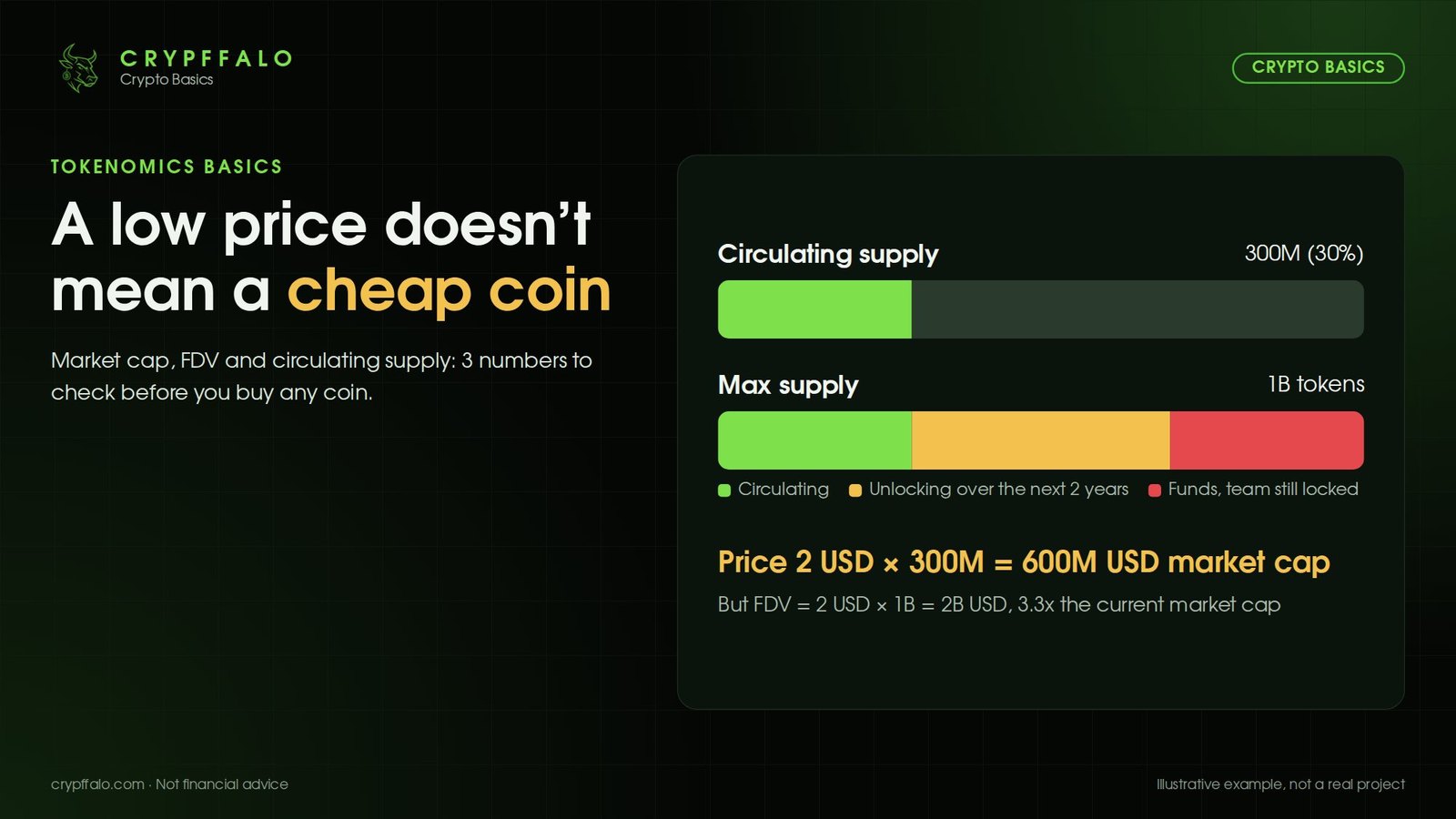
- Illustrative example: a project trades at 2 USD with 300 million tokens circulating out of a total of 1 billion. Its market cap is 600 million USD, but its FDV is 2 billion USD, about 3.3x higher. If all of the remaining 700 million tokens reach the market without demand rising, the price will struggle to hold at 2 USD.
4. Example: Two Coins Priced at 1 USD
These are two hypothetical projects for comparison:
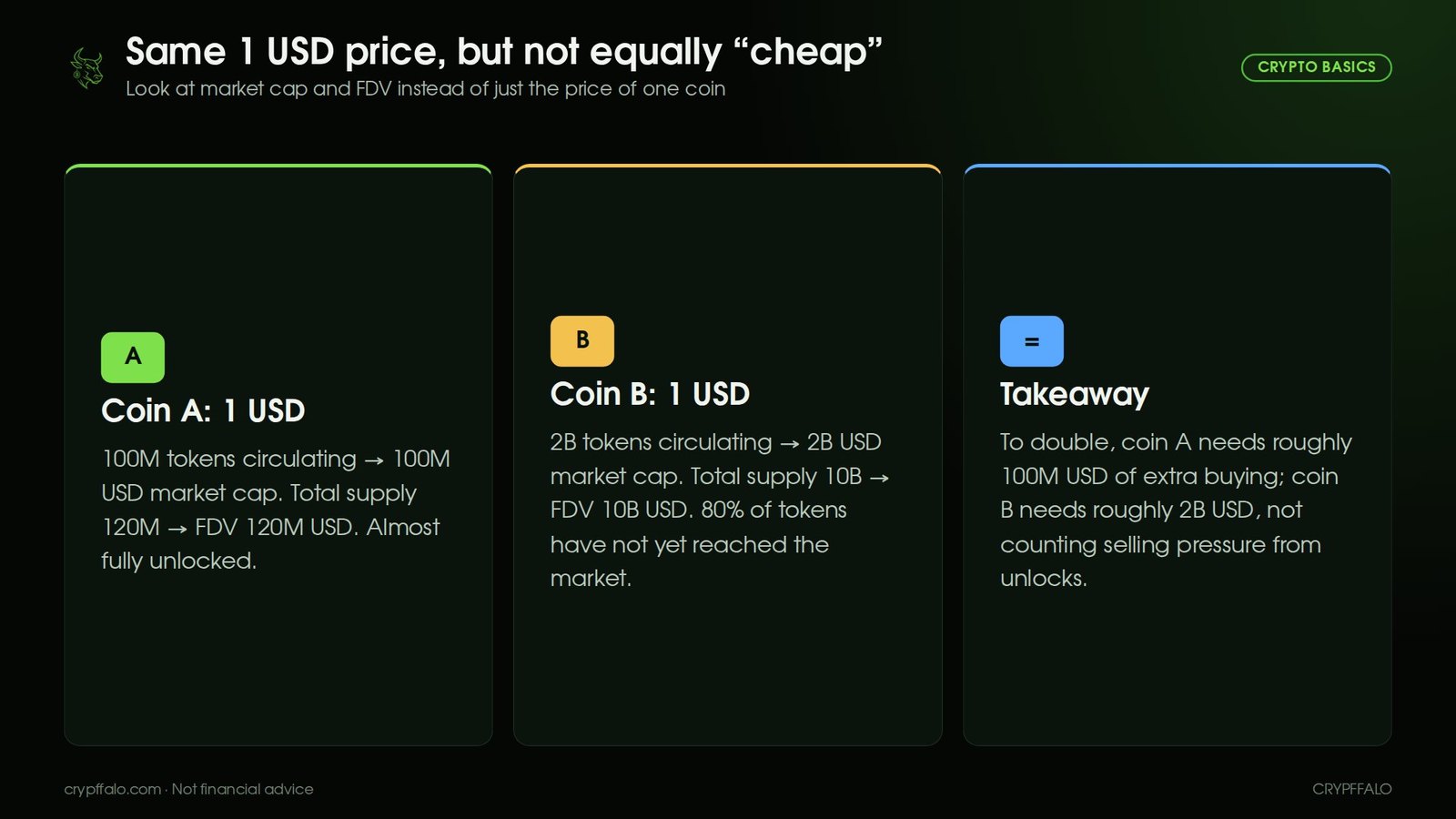
- Coin A: price 1 USD, 100 million tokens circulating, market cap 100 million USD, total supply 120 million (FDV 120 million USD). Almost fully unlocked.
- Coin B: price 1 USD, 2 billion tokens circulating, market cap 2 billion USD, total supply 10 billion (FDV 10 billion USD). 80% of tokens have not yet reached the market.
- The prices look the same, but to double, coin A needs roughly 100 million USD of extra buying, while coin B needs roughly 2 billion USD, not counting the selling pressure from the 8 billion tokens still to be unlocked.
5. Token Unlock Schedules
Most projects allocate tokens to investors, the team and the ecosystem, then lock them and release them gradually on a schedule (vesting). A few points to watch:
- Large unlocks (a few percent of supply or more) are often "priced in" by the market: the price may fall in the days before and after.
- Who receives the tokens matters: investors who bought at very low prices have a stronger incentive to take profit than an ecosystem fund.
- Projects can change their unlock schedule or buy back tokens from investors. Always check the project's official announcements.
- You can track unlock schedules on token unlock data sites and each project's official information pages.
6. Trading Volume and Liquidity
- 24-hour volume that is very low relative to market cap (e.g. below 1–2%) means few people are trading. Large orders are prone to slippage, and it is hard to exit when you need to.
- A volume spike with a sharp price rise can be real capital inflow, but it can also be a short-term pump. See how to read volume in Volume and Breakouts.
- Favor coins listed on several major exchanges with a derivatives market. You can view Long/Short, funding and liquidation data for each coin on the Coin Data page.
7. Tokenomics Checklist Before Buying
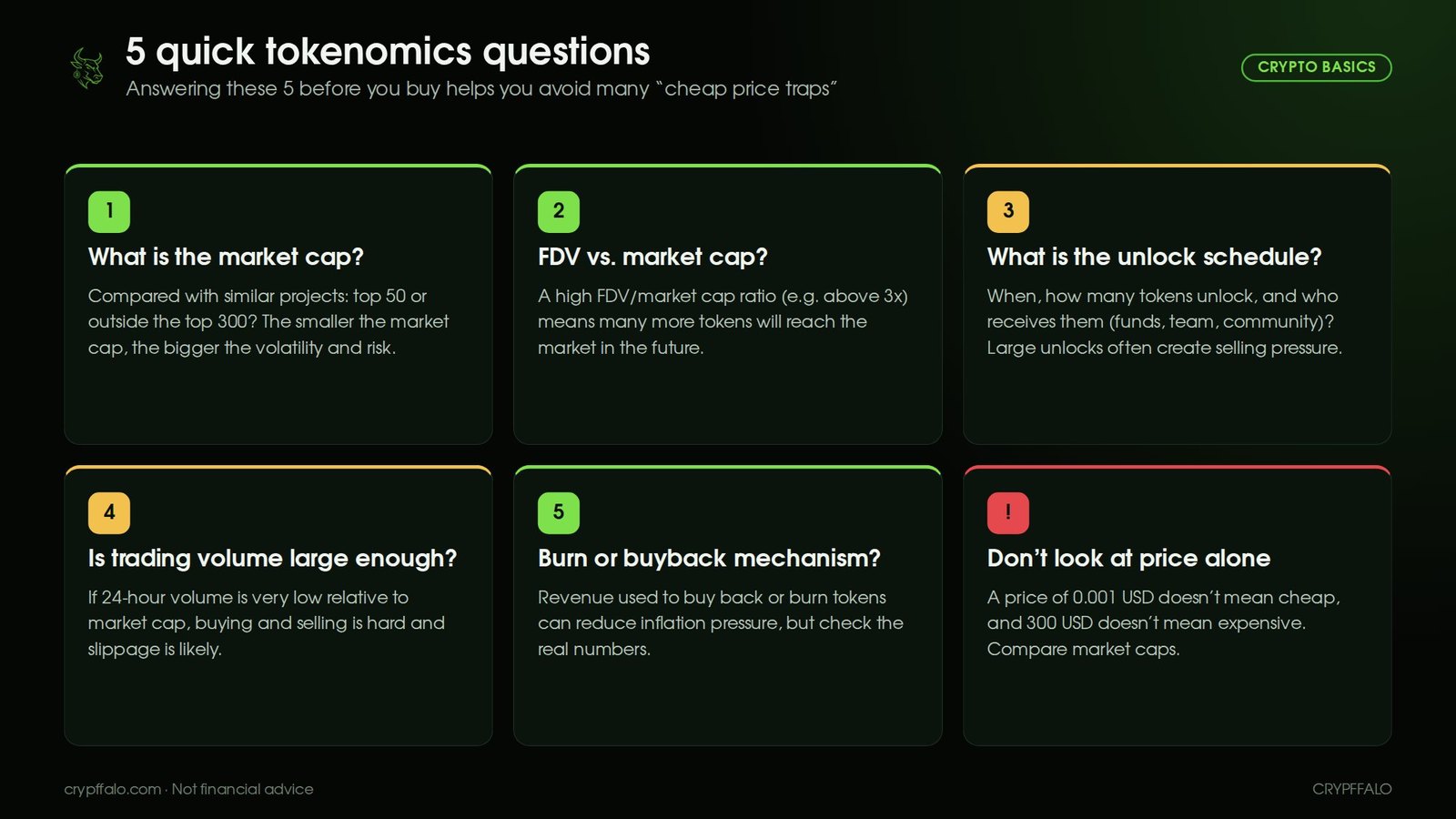
- What is the market cap, and how does it rank among similar projects?
- How many times larger than market cap is the FDV?
- When is the next large unlock, what percentage of supply is it, and who receives it?
- Is 24-hour trading volume large enough relative to market cap?
- Does the project have real revenue, and a token buyback or burn mechanism?
Only then think about your entry and stop loss; see Risk Management for Beginners.
Frequently Asked Questions
What is market capitalization?
Market capitalization is the total value of the coins in circulation, equal to the price of one coin multiplied by circulating supply. It is a more accurate way to compare project sizes than looking at price alone.
What is FDV and how is it different from market cap?
FDV is the project's valuation if all tokens (max supply) had been issued, equal to price multiplied by max supply. Market cap only counts the circulating portion. An FDV many times higher than market cap means many more tokens will reach the market.
Is a low-priced coin a cheap coin?
No. The price of one coin depends on the number of tokens. A coin priced at 0.001 USD can still have a market cap of billions of USD. To know whether it is cheap or expensive, compare its market cap and FDV with similar projects.
What FDV-to-market-cap ratio is considered high?
There is no fixed threshold, but when FDV is about 3x market cap or more, most tokens are not yet circulating and you should check the unlock schedule carefully before buying.
How do token unlocks affect price?
Unlocks increase the supply available to sell. If recipients (investors, the team) sell without demand rising accordingly, the price usually comes under downward pressure, especially with large unlocks.
Note
This article is for educational purposes; the examples are hypothetical projects. This is not financial advice. Verify figures from official sources before making any decision.
Tags: Crypto Basics, Tokenomics, Market Cap, FDV, Token unlock
Related articles
- What is Bitcoin dominance? How to read BTC.D to spot altcoin season (with examples)
- What Are Bollinger Bands? How to Read the Squeeze, %B and BandWidth (With Examples)
- What Is DCA? How to Dollar-Cost Average Into Bitcoin (With Examples)
- What Is MACD? How to Read Crossovers, Histogram and Divergence (With Examples)
- Reversal Candlestick Patterns: Pin Bar, Engulfing, Doji and How to Read Them in the Right Place
- Fibonacci Retracement: How to Find Entry Zones on Pullbacks, Set Stop Loss and Targets