Crypto exit plan: take profit in parts and lock in gains
Author: Crypffalo Research · 14:47 21/10/2026
How to take profit in parts, lock gains with a trailing stop and when to exit early, so crypto swing trades do not turn green into red.

A good entry is only half the trade. The other half is the exit: where to take profit, when to move your stop, and when to close even though the target has not been hit.
Many traders watch profits turn into losses simply because they had no exit plan. This article covers taking profit in parts, locking in gains with a trailing stop, and using holding time as an exit rule.
Quick summary
- The problem: In profit but not taking it, price reverses and the trade ends flat or red. In a loss, holding and hoping.
- Why: No exit plan written before entry, so every decision follows the emotion of the moment.
- Partial profits: Split the position into 2–3 parts and take profit at resistance levels instead of betting everything on one price.
- Locking gains: Once price has moved enough, move the stop to entry or higher so the trade can no longer lose.
- Tool: Trade Copilot alerts you at targets, reminds you to move the stop and warns you when the trend turns.
Why do traders take profits too early and cut losses too late?
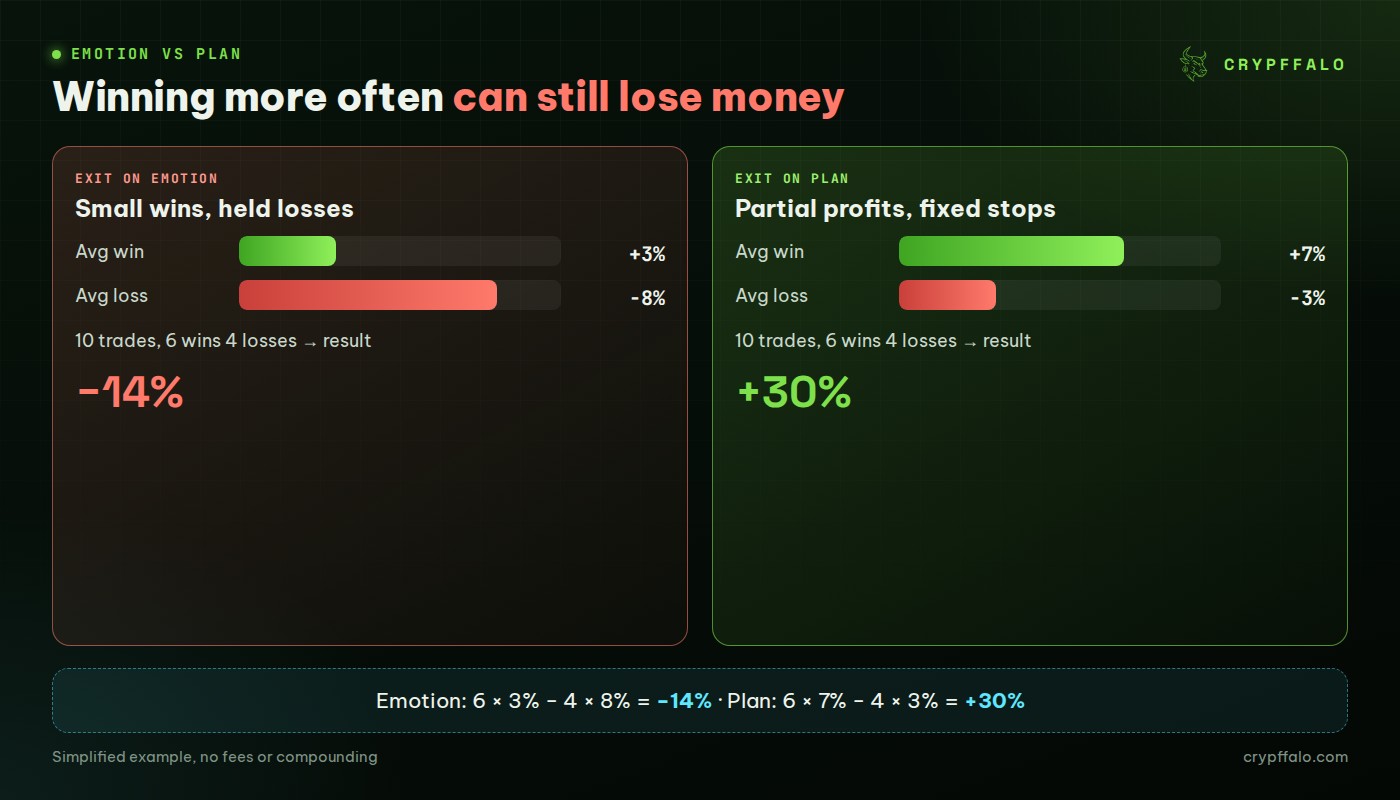
Behavioral finance calls this the disposition effect: investors tend to sell winners early to "lock it in" and hold losers too long to avoid admitting a mistake.
The result is small wins and large losses. Even with a win rate above 50%, the account can still shrink.
The fix is not trying to "stay calm". The fix is deciding every exit in advance, writing it down, and letting the plan do the work instead of emotions.
Three exits every plan should include
Binance Academy lists several common exit strategies. For crypto swing trades, these three cover most situations.
- Take profit at levels: Set 2–3 targets at resistance zones above.
- Trailing stop: Move the stop up with price once the trade is in profit to protect gains.
- Time-based exit: If price has not moved your way after a set time, close and free up capital.
How does taking profit in parts work?
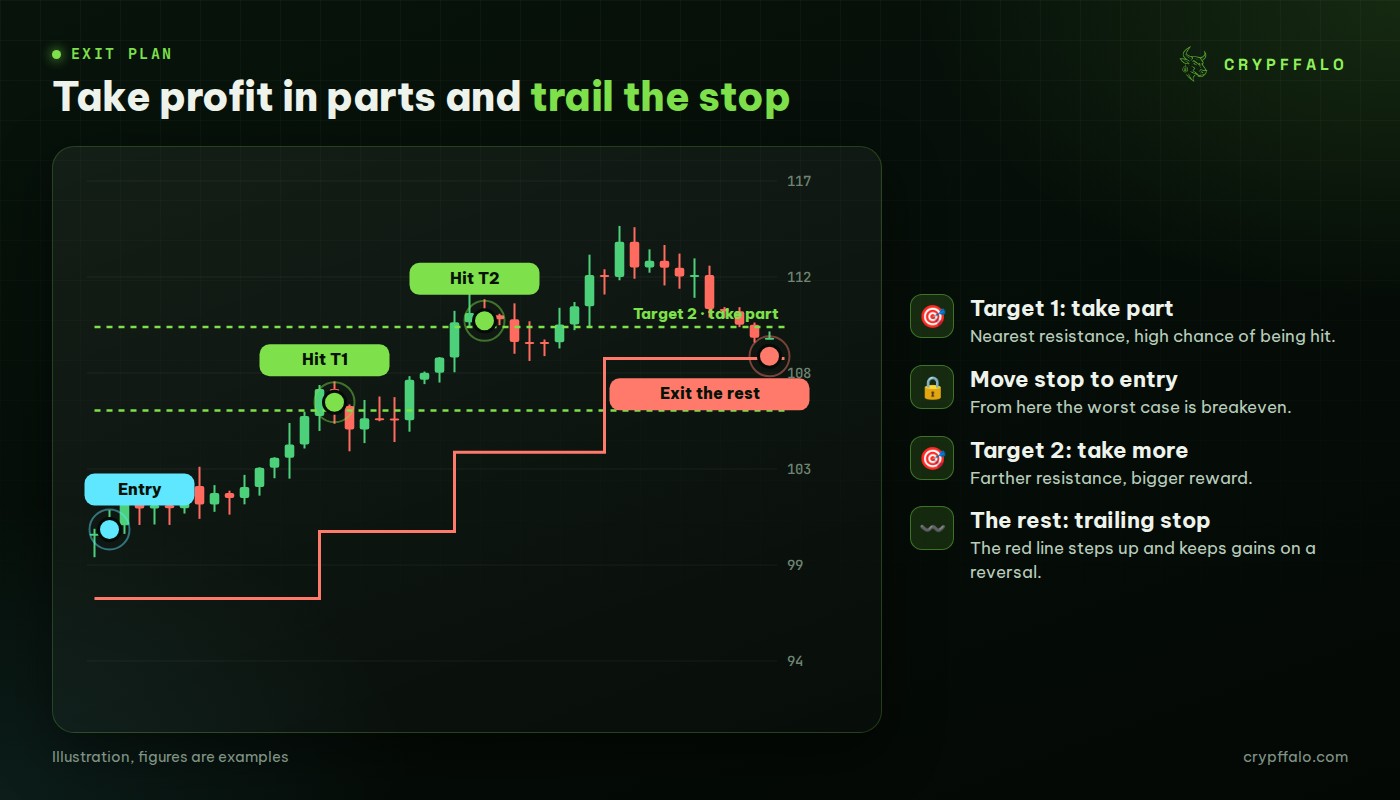
Instead of selling everything at one level, you split the position. For example: take part at the nearest target, part at the second target, and let the rest run with a trailing stop.
This removes two fears at once. You do not fear missing the next leg because you still hold a position. You do not fear giving everything back because part is already banked.
- Target 1: The nearest resistance where sellers tend to appear. Higher chance of being hit.
- Target 2: A farther resistance or previous high. Lower chance but bigger reward.
- The rest: Held with a trailing stop until the trend shows signs of reversing.
Locking in gains with a trailing stop
A trailing stop moves up with price. When price rises, the stop rises too. When price turns down, the stop stays put and closes the trade if hit.
A simple rule: once price has moved a clear distance from entry, move the stop to your entry price. From then on, the worst case is breakeven.
Do not trail too tight. Crypto is volatile and a tight stop gets hit by normal swings. Many traders use ATR to pick a sensible distance.
When should you exit before the target?
A good plan has conditions, not just prices. These are valid reasons to close early.
- Higher-timeframe trend breaks: For example, an H4 candle closes below a key support zone.
- Money flow flips: Aggressive sellers take over, the funding rate overheats, or leverage piles up on the long/short ratio.
- Big macro news ahead: CPI or FOMC can move price sharply both ways. Check the event calendar.
- Held too long: Price ranging for too long means your reason for entering has weakened.
How does Trade Copilot help with exits?
Exiting on time means watching price constantly, which is hard when you have a day job. Trade Copilot watches for you on Telegram.
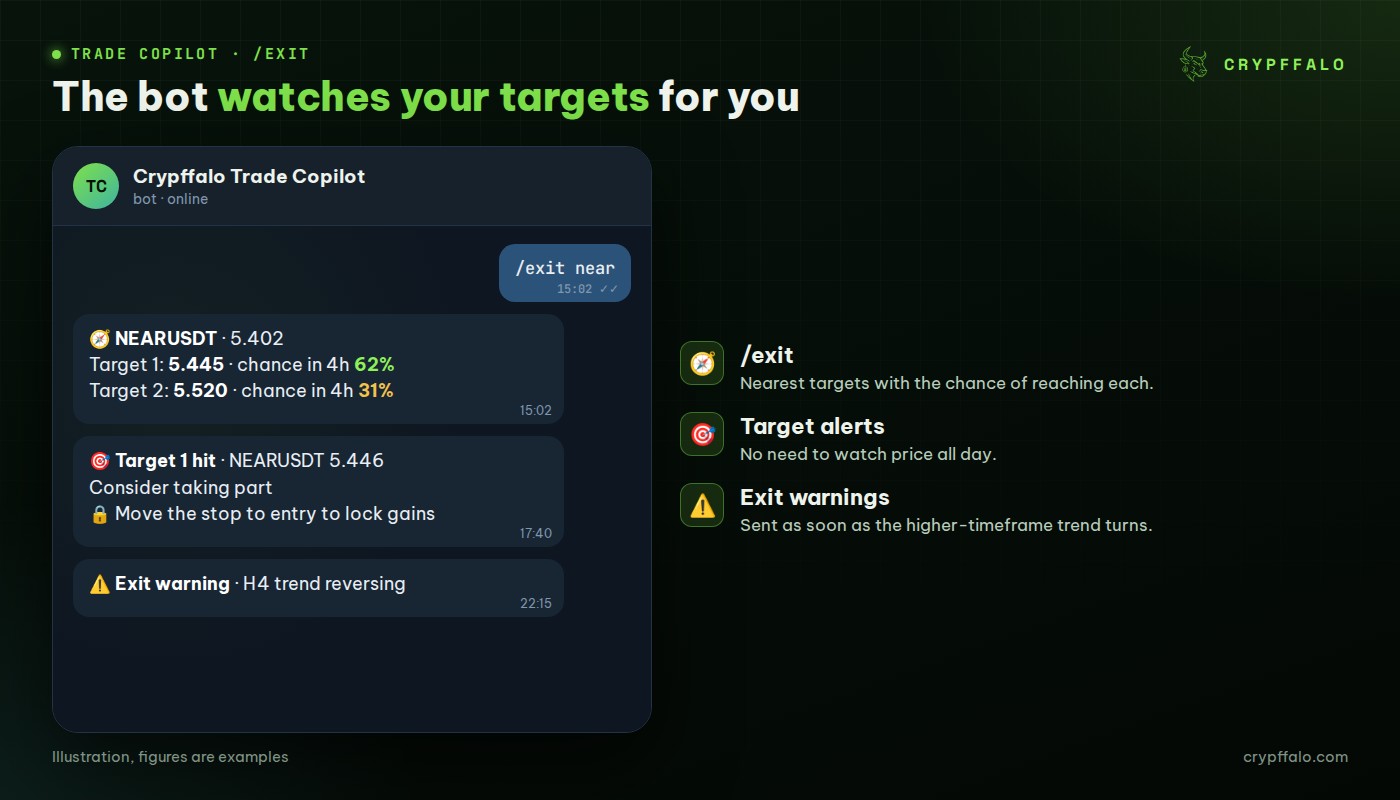
- Type /exit with a coin name: The bot returns the nearest take-profit levels with the chance of reaching each in the next few hours.
- Target alerts: When price hits a target, the bot messages you to take part.
- Stop reminders: When the trade is far enough in profit, the bot reminds you to move the stop and lock in gains.
- Exit warnings: When the higher-timeframe trend turns, the bot warns you right away.
Every trade the bot sends has a stop loss, targets and a maximum holding time from the start. You can see pricing and request a free trial.
Key takeaways
- Write your exit plan before entering, not while in profit.
- Take profit in parts to bank gains without missing the next leg.
- Move the stop to entry once the trade has moved far enough, but do not trail too tight.
- Exit early when your reason for entering is no longer valid, even before the target.
Read next: crypto entry points: why the right coin can still lose money and a 5-step daily trading routine.
FAQ: frequently asked questions
How much should I take off at each target?
There is no fixed ratio. Many traders take about half at the first target and split the rest between the second target and a trailing stop.
When is the right time to move the stop to entry?
When price has moved a clear distance from entry and cleared the nearest resistance. Moving it too early gets you stopped out by normal pullbacks.
Does Trade Copilot close trades when the stop is hit?
No. The bot only alerts and warns on Telegram. You should place stop-loss and take-profit orders on the exchange.
Tags: exit strategy, take profit, trailing stop, risk management, Trade Copilot
Related articles
- Crypto entry points: why the right coin can still lose money
- 7 crypto trading mistakes: chasing price, holding losers, over-leverage
- A 5-step daily crypto trading routine with a Telegram assistant
- What is Bitcoin dominance? How to read BTC.D to spot altcoin season (with examples)
- What Are Bollinger Bands? How to Read the Squeeze, %B and BandWidth (With Examples)
- What Is DCA? How to Dollar-Cost Average Into Bitcoin (With Examples)