Crypto entry points: why the right coin can still lose money
Author: Crypffalo Research · 15:47 21/10/2026
Why the entry decides a swing trade, 3 common entry mistakes (chasing, dip buying, ignoring BTC) and a 4-step check before you buy.

Many traders pick the right coin in the right trend and still end up red. The reason is often not the coin but the entry point: buying after price has already run, or placing a stop loss too wide or too tight.
This article explains why the entry decides most of a swing trade's outcome, the three common entry mistakes in crypto, and a 4-step check to run before you hit buy.
Quick summary
- The problem: The same coin rises 20%. Someone who bought at a structure zone is in profit, someone who chased a long green candle gets stopped out.
- Why: Entering far from support forces a wide stop, so the risk/reward is poor from the start.
- Three common mistakes: Chasing price on FOMO, catching a falling knife, and ignoring BTC context.
- The fix: A 4-step check: context, price zone, confirmation, stop loss and position size.
- Tool: Trade Copilot scores each entry with the /entry command and says "not yet" when conditions are missing.
What is an entry point and why does it matter more than picking the coin?
The entry point is the price where you open the position. It sets the distance to your stop loss and the distance to your take-profit target.
With a short distance to the stop, you can use a sensible size and lose only a small part of the account if wrong. With a long distance, a normal shake-out can turn the trade into a big loss.
So two people can buy the same coin and sell at the same level with opposite results. The one who entered at structure has a 1:3 risk/reward. The one who chased the candle top has about 1:0.8.
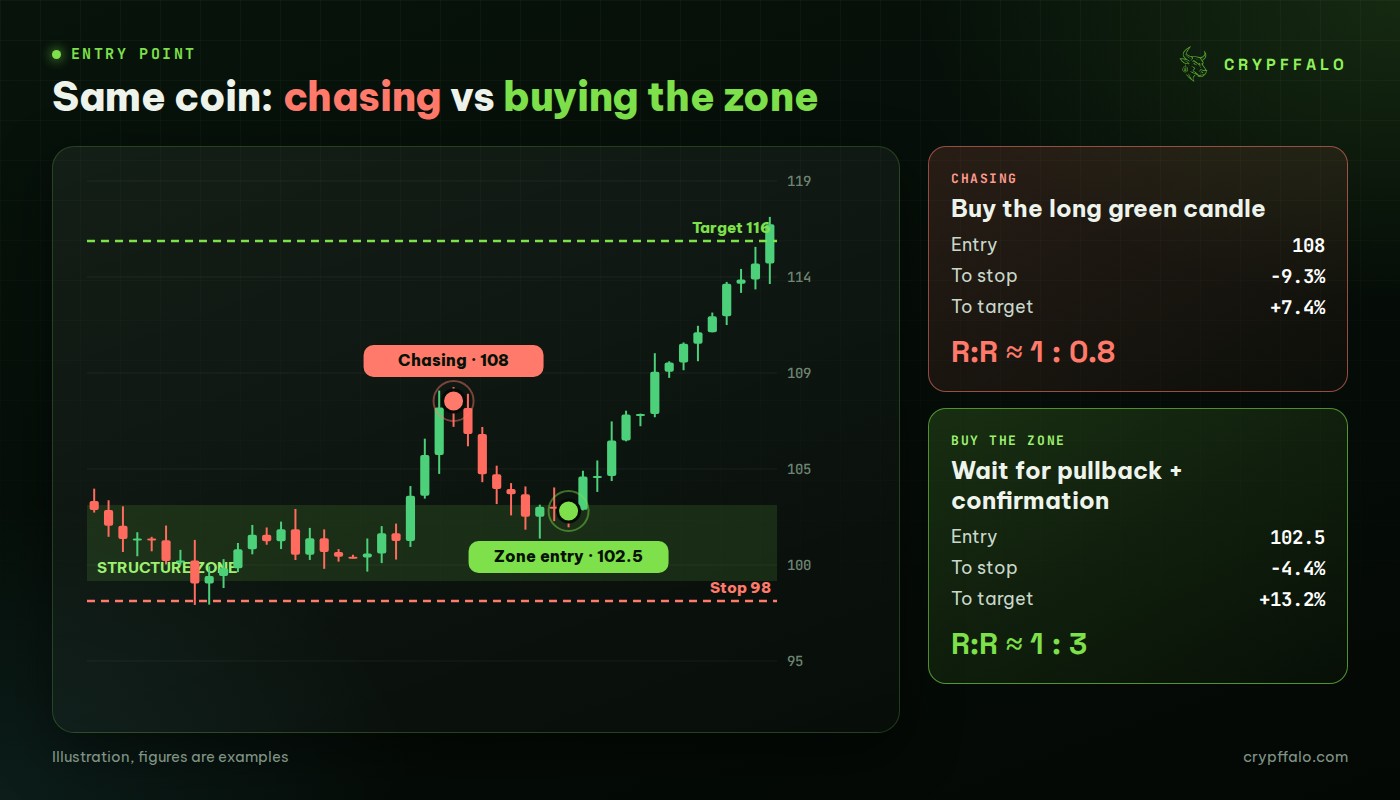
Mistake 1: Chasing a long green candle
A long green candle brings the feeling of "buy now or miss out". Binance Academy calls this FOMO, the fear of missing out, one of the emotions behind rushed decisions.
After a strong move, price often pulls back to retest the level it just broke. Whoever bought the top of the candle has to sit through that whole pullback before seeing profit.
- Signs you are chasing: Price is more than one ATR away from the nearest support, and you cannot say where your stop goes.
- What to do instead: Write down the zone you want to buy, set an alert, and wait for price to return with a confirming candle.
Mistake 2: Buying the dip while price is still falling
"It is down 40%, it must bounce" is a common thought. But cheaper than yesterday does not mean price has stopped falling.
A good entry needs signs that selling is fading: a long lower wick at a structure zone, aggressive buyers stepping in, or price holding above the previous low. Without them, dip buying is a guess.
Mistake 3: Ignoring BTC and the overall market
Most altcoins move with BTC during sharp moves. A clean altcoin setup can fail just because BTC drops 3% in an hour.
Before entering an altcoin, check BTC's trend, whether BTC Dominance is rising or falling, and whether a macro release is coming up in the event calendar.
A 4-step check before every entry
You do not need many indicators. These four questions filter out most rushed trades.
- Step 1, context: Is the higher timeframe (H4, D1) rising, ranging or falling? Is BTC adding pressure?
- Step 2, price zone: Is price near a structure zone (old support, accumulation range, high-volume area) or floating between zones?
- Step 3, confirmation: Is there a reversal candle, aggressive buying, or price holding the zone?
- Step 4, risk: Where does a sensible stop go? At that distance, what size keeps the loss at 1–2% of the account if wrong?
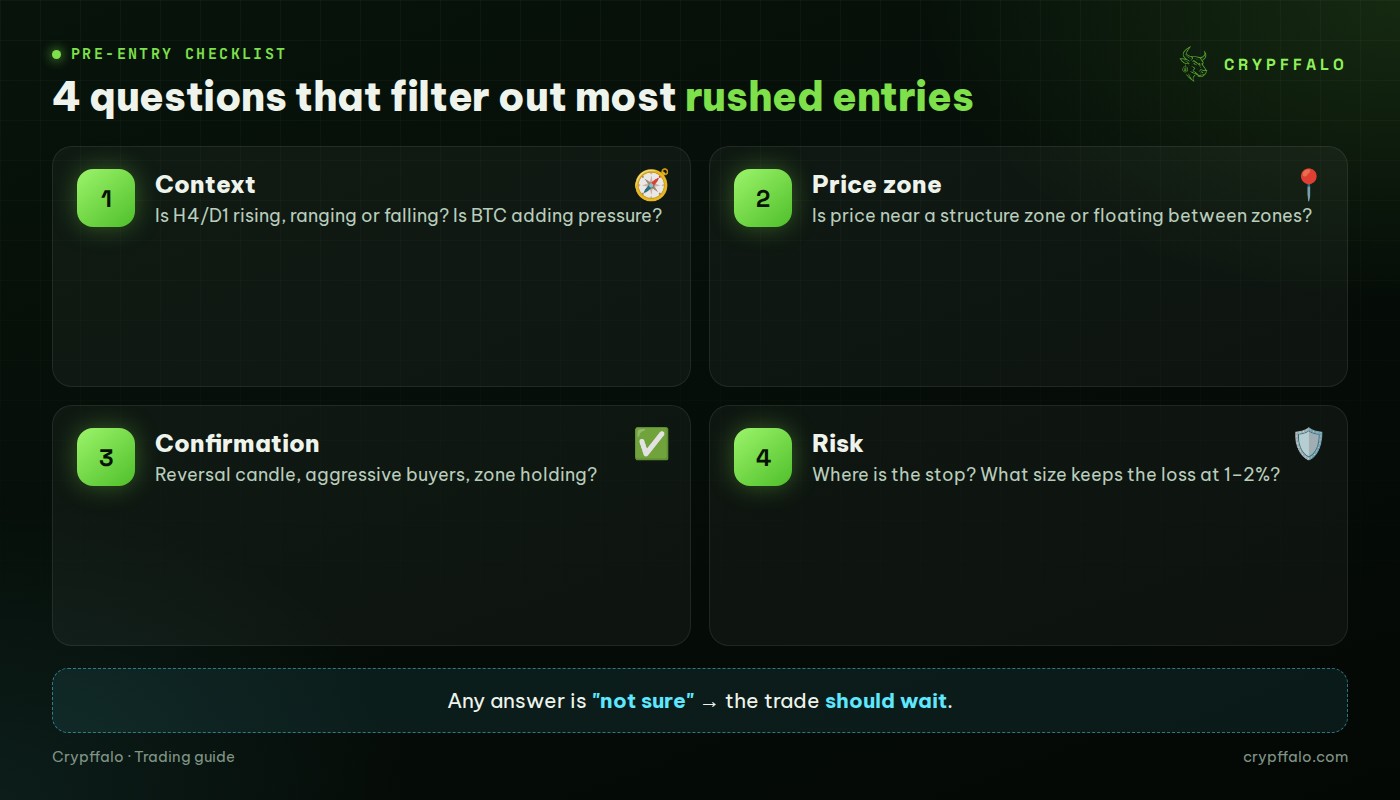
If any answer is "not sure", the trade should wait. Crypto trades 24/7, new setups keep coming, and a lost account is hard to rebuild.
Money flow separates real buying from leverage-driven pumps
Two rallies that look the same on the chart can be very different. One is driven by spot buyers, the other by leveraged futures positions piling in.
A leverage-driven rally usually comes with a rising funding rate and fast Open Interest growth. When longs are forced to close, price can drop quickly, as you can see on the liquidation map.
So before buying into a rally, check whether spot flow confirms it. The money flow page on Crypffalo tracks this coin by coin.
How does Trade Copilot check an entry?
Trade Copilot is Crypffalo's trading assistant on Telegram. Type /entry with a coin name and the bot replies in seconds: enter or not yet, where the nearest buy zone is, and which conditions are missing.
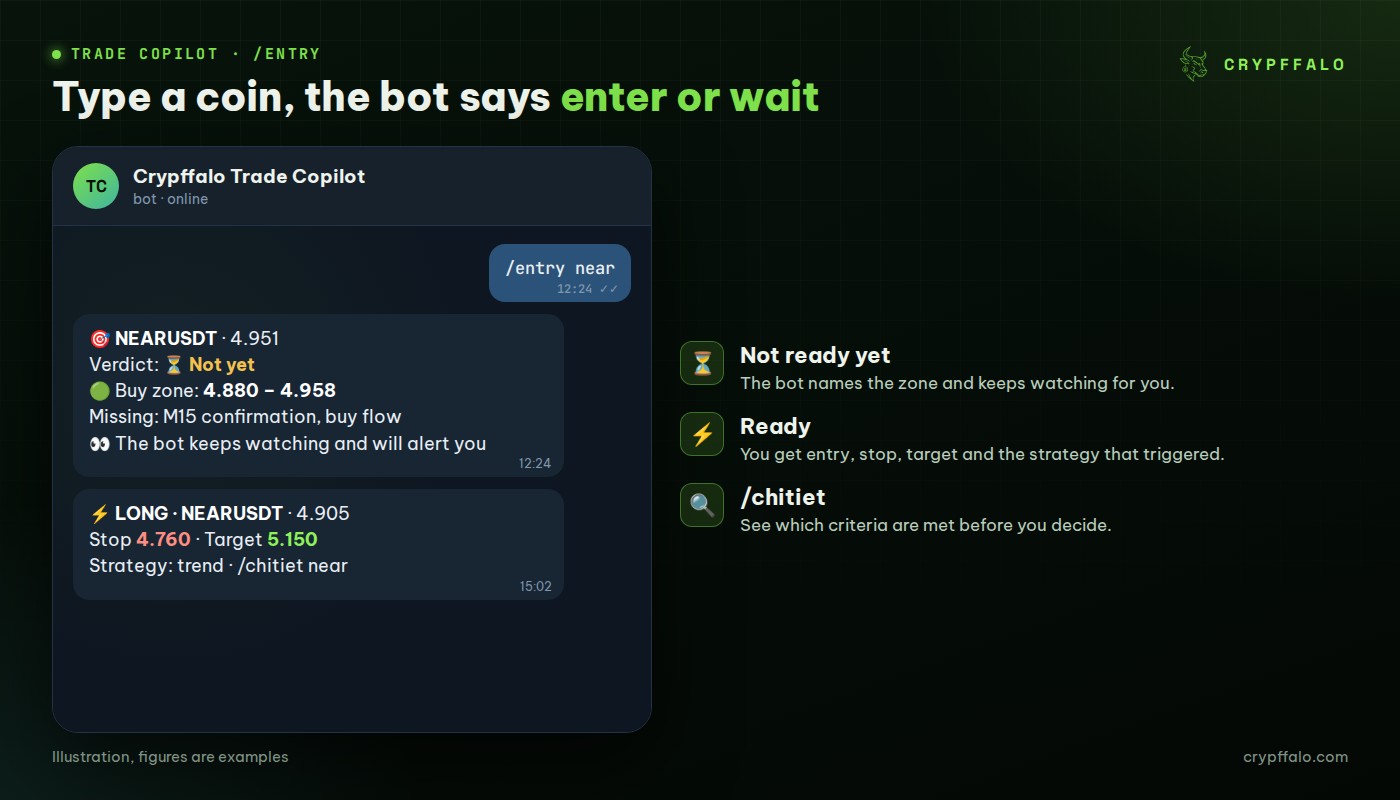
- When it is not time yet: The bot names the zone to wait for and keeps watching, messaging you only when conditions are met.
- When conditions are met: The bot sends the entry, stop loss and take-profit targets, plus which strategy triggered.
- See the reasons: Type /chitiet to see each criterion, from trend and structure to multi-exchange money flow.
The bot only suggests LONG trades and never places orders on the exchange. The final decision is always yours. You can see pricing and request a free trial before choosing a plan.
Key takeaways
- Picking the coin is only half of it. The entry decides how much you lose if wrong.
- Do not buy when price has run far from support. Write down your zone and wait.
- Always check BTC context and money flow before entering an altcoin.
- Calculate stop loss and size before you click buy, not after.
Read next: crypto exit plan: take profit in parts and lock in gains and 7 crypto trading mistakes.
FAQ: frequently asked questions
How do I know if I am chasing price?
If price is far from the nearest support and you cannot place a sensible stop loss, you are probably chasing. Wait for a pullback to the zone.
Where should the stop loss go on a swing entry?
Usually below the structure zone you bought, where a break would mean your reason for entering is no longer valid. That distance sets your size.
Does Trade Copilot place trades for me?
No. The bot scores setups, sends suggestions and reminders on Telegram. You place orders on the exchange and make the decision.
Tags: entry point, technical analysis, risk management, FOMO, Trade Copilot
Related articles
- Crypto exit plan: take profit in parts and lock in gains
- 7 crypto trading mistakes: chasing price, holding losers, over-leverage
- A 5-step daily crypto trading routine with a Telegram assistant
- What is Bitcoin dominance? How to read BTC.D to spot altcoin season (with examples)
- What Are Bollinger Bands? How to Read the Squeeze, %B and BandWidth (With Examples)
- What Is DCA? How to Dollar-Cost Average Into Bitcoin (With Examples)