7 crypto trading mistakes: chasing price, holding losers, over-leverage
Author: Crypffalo Research · 13:47 21/10/2026
7 common crypto trading mistakes in numbers: a 50% loss needs 100% to recover, 20x leverage liquidates on a 5% move, and how to fix each.

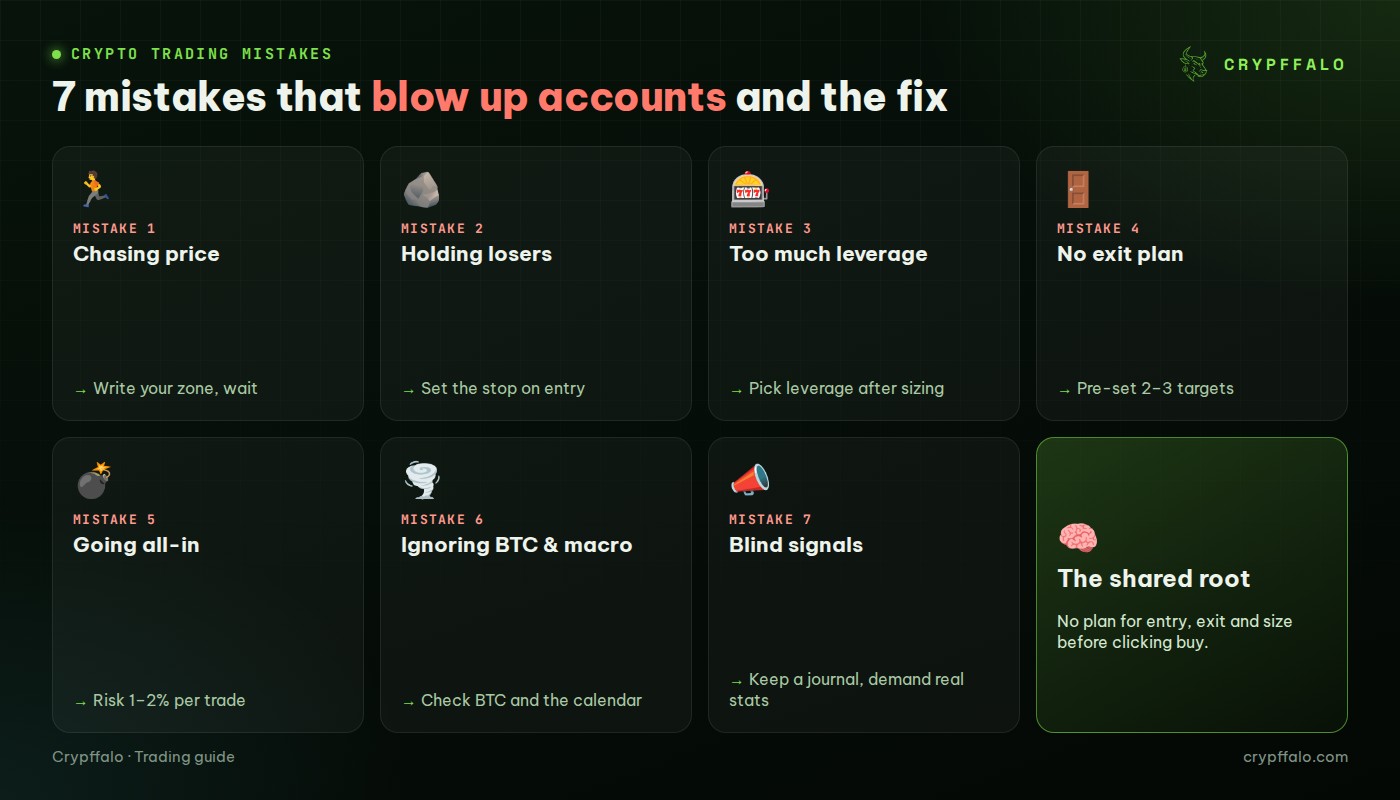
Most crypto accounts do not blow up because of one unlucky trade. They blow up from the same repeated mistakes: chasing price, holding losers, using too much leverage, and trading without a plan.
This article covers 7 common crypto trading mistakes, shows with real numbers why they are dangerous, and explains how to fix each one.
Quick summary
- A common mistake: Chasing price on FOMO, entering after price has run far from support.
- A costly mistake: Holding losers. A 50% loss needs a 100% gain to get back to even.
- An account-killer: High leverage. At 20x, a move of about 5% against you can liquidate the position.
- The shared root: No plan for entry, exit and size before clicking buy.
- The fix: Write a plan, cap risk at 1–2% of the account per trade, and let a tool like Trade Copilot do the watching.
Mistake 1: Chasing price on FOMO
FOMO, the fear of missing out, makes traders buy the moment a coin pumps or someone shows off profits. By then price is usually far from support.
Buying the top of a candle means a very wide stop, or no sensible place for one. A normal pullback is enough to turn the trade red.
- Fix: Write down the zone you want and wait for price to return. See the full breakdown in crypto entry points.
Mistake 2: Holding losers, waiting to "get back to even"
Holding a losing trade in the hope it comes back runs into simple math: the deeper the loss, the bigger the gain needed to break even.
- 10% loss: needs about an 11% gain.
- 25% loss: needs about 33%.
- 50% loss: needs 100%.
- 70% loss: needs about 233%.
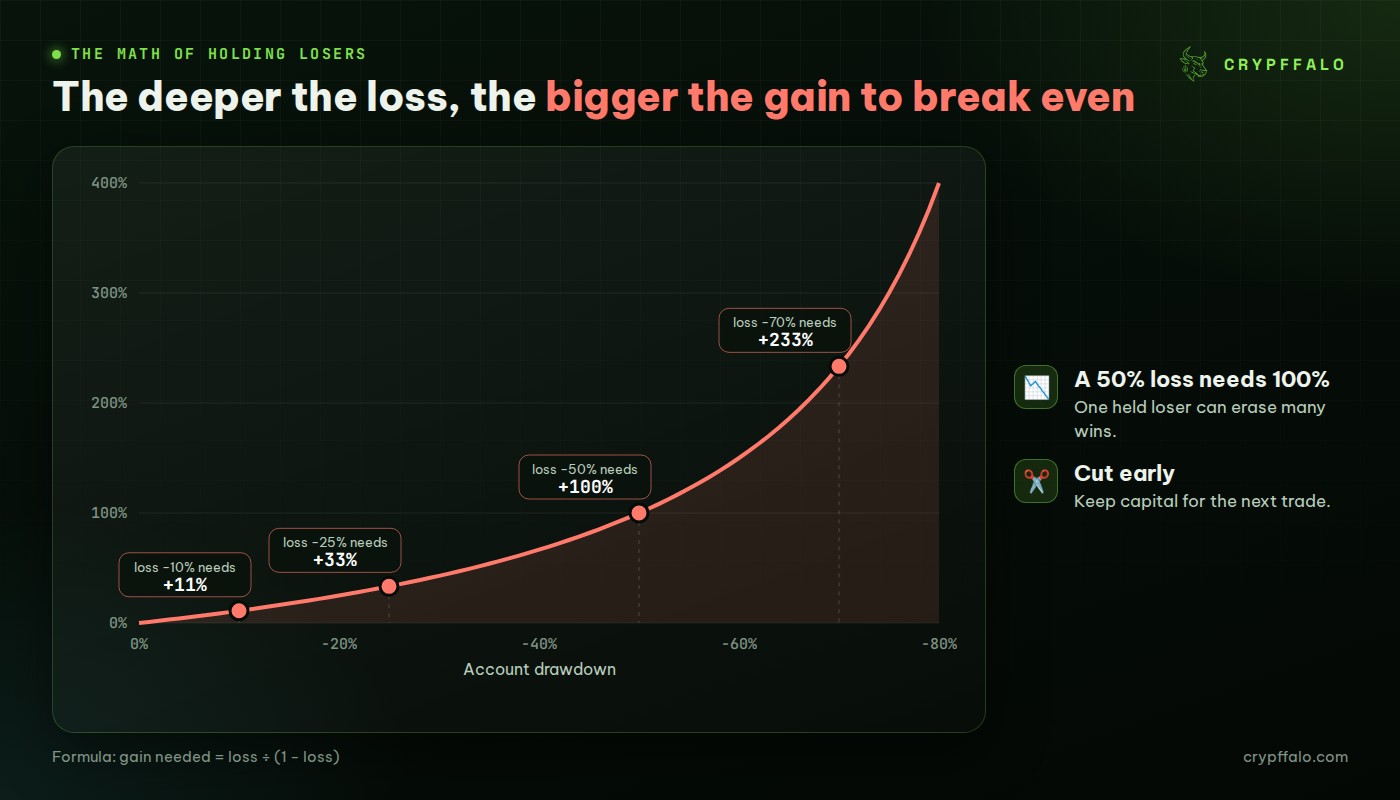
Looking at the curve, cutting a loss early is not "losing". It keeps capital alive for the next trade.
- Fix: Place the stop loss on the exchange as soon as you enter, and never move it lower.
Mistake 3: Using too much leverage
Leverage magnifies both gains and losses. With isolated margin, the distance to liquidation is roughly 100% divided by the leverage (before fees and maintenance margin).
- 5x: about a 20% move against you.
- 10x: about 10%.
- 20x: about 5%.
- 50x: about 2%.
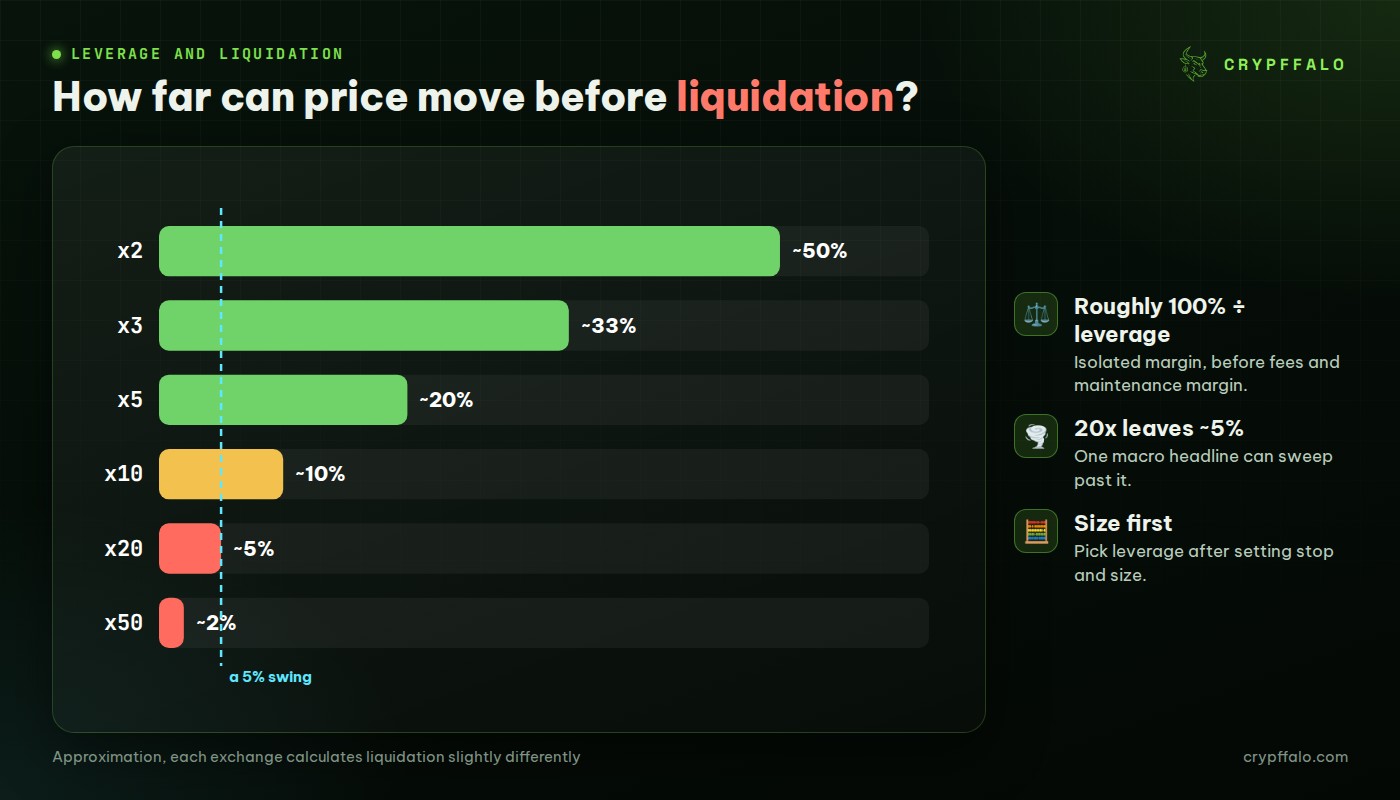
Crypto can move 5% in an hour, especially around macro news. You can see how mass liquidations unfold on the liquidation map.
- Fix: Choose leverage after you have set your stop and size, not before. For swing trades, lower leverage is usually safer.
Mistake 4: No exit plan
Many traders know exactly why they bought but not when to sell. They take small profits too early and hold losses too long.
- Fix: Before entering, write 2–3 take-profit levels and your conditions for an early exit. Details in the crypto exit plan.
Mistake 5: Going all-in on one trade
Putting most of the account into one trade turns every decision into a gamble. A few losses in a row and the account struggles to recover.
Binance Academy recommends sizing positions by the amount you are willing to lose, not by how confident you feel.
- Fix: Position size = amount you accept to lose ÷ distance to stop. Example: a 2,000 USDT account, risking 1% (20 USDT) with a 4% stop gives a position of about 500 USDT.
Mistake 6: Trading against BTC and macro news
Altcoins usually follow BTC in strong moves. Buying altcoins while BTC breaks down, or right before CPI or FOMC, adds risk you do not need.
- Fix: Check BTC's trend, BTC Dominance and the event calendar before entering.
Mistake 7: Following unverified signals and keeping no journal
Following chat-group signals without knowing the reasoning or the real win rate hands your decisions to someone else. Without a trading journal, you also cannot see where you go wrong.
- Fix: Log every trade: reason, entry, stop, result. Only use signal sources that publish both wins and losses.
A tool that helps avoid these 7 mistakes
Knowing the mistakes is one thing. Avoiding them in a fast market is another. Trade Copilot is built to handle the discipline part for you on Telegram.
- Against chasing: /entry scores the entry and says "not yet" when price has run too far.
- Against holding losers: Every suggestion comes with a stop loss and a maximum holding time.
- Against all-in: /profile sizes the position and leverage from your capital and the amount you accept to lose.
- Against trading blind: The bot checks BTC context and multi-exchange money flow before suggesting a trade.
- Transparency: /thongke publishes both winning and losing trades.
You can see pricing and request a free trial to try it first.
FAQ: frequently asked questions
Which mistake loses money fastest in crypto trading?
High leverage without a stop loss. At 20x, a move of about 5% against you can liquidate the position.
How much of my account should I risk per trade?
Many traders cap risk at 1–2% per trade. That lets the account survive a losing streak without major damage.
How do I stop chasing price?
Write down the zone you want to buy, set a price alert, and only enter when price returns to that zone with a confirming signal.
Tags: trading mistakes, chasing price, leverage, money management, Trade Copilot
Related articles
- Crypto entry points: why the right coin can still lose money
- Crypto exit plan: take profit in parts and lock in gains
- A 5-step daily crypto trading routine with a Telegram assistant
- What is Bitcoin dominance? How to read BTC.D to spot altcoin season (with examples)
- What Are Bollinger Bands? How to Read the Squeeze, %B and BandWidth (With Examples)
- What Is DCA? How to Dollar-Cost Average Into Bitcoin (With Examples)