Web3Auth flaw exposes Keplr wallet keys as $6 million moves across Cosmos chains
Author: Crypffalo Research · 02:54 09/11/2026
Keplr disabled Google and Apple logins after a Web3Auth flaw exposed private keys. Bitquery traced about $6.01 million in transfers, but Web3Auth says it rescued about $5.6 million.

Keplr, one of the most widely used wallets in the Cosmos ecosystem, has suspended Google and Apple logins after a flaw at authentication provider Web3Auth exposed private keys for part of its user base. Analytics firm Bitquery traced about $6.01 million in assets moved out of roughly 44,700 wallets on Nov. 6–7.
On Nov. 8, Web3Auth said it had moved about $5.6 million out of exposed wallets to get ahead of the attackers. That means the $6.01 million figure reflects total transfers, not confirmed theft.
Key takeaways
- Incident: A flaw in infrastructure run by Consensys-owned Web3Auth exposed private keys for some Keplr wallets created with Google or Apple logins.
- Scale: Bitquery counted about 44,700 wallets across eight networks and roughly $6.01 million in outgoing transfers, with about $3.5 million on Cosmos Hub.
- Rescue: Web3Auth says it moved about $5.6 million into recovery wallets to protect users.
- Not affected: Wallets created with a seed phrase or hardware wallet; Web3Auth says it has found no evidence MetaMask users were impacted.
- Still unknown: How much the attackers actually took and how the keys were exposed.
What happened
Web3Auth lets users create crypto wallets with existing social accounts, so newcomers don't have to manage a recovery phrase. On Nov. 6, the company disclosed a security issue in infrastructure used by third-party services.
By Nov. 7, Keplr was receiving reports of unauthorized transactions on accounts created through Google or Apple. It disabled both login methods and began investigating with Web3Auth.
Keplr co-founder Josh Lee said the wallet's own code was not hacked and that the incident originated at Web3Auth. He estimated that about 20% of Google and Apple login accounts could be affected, though only a fraction were actually exploited.
What Bitquery found
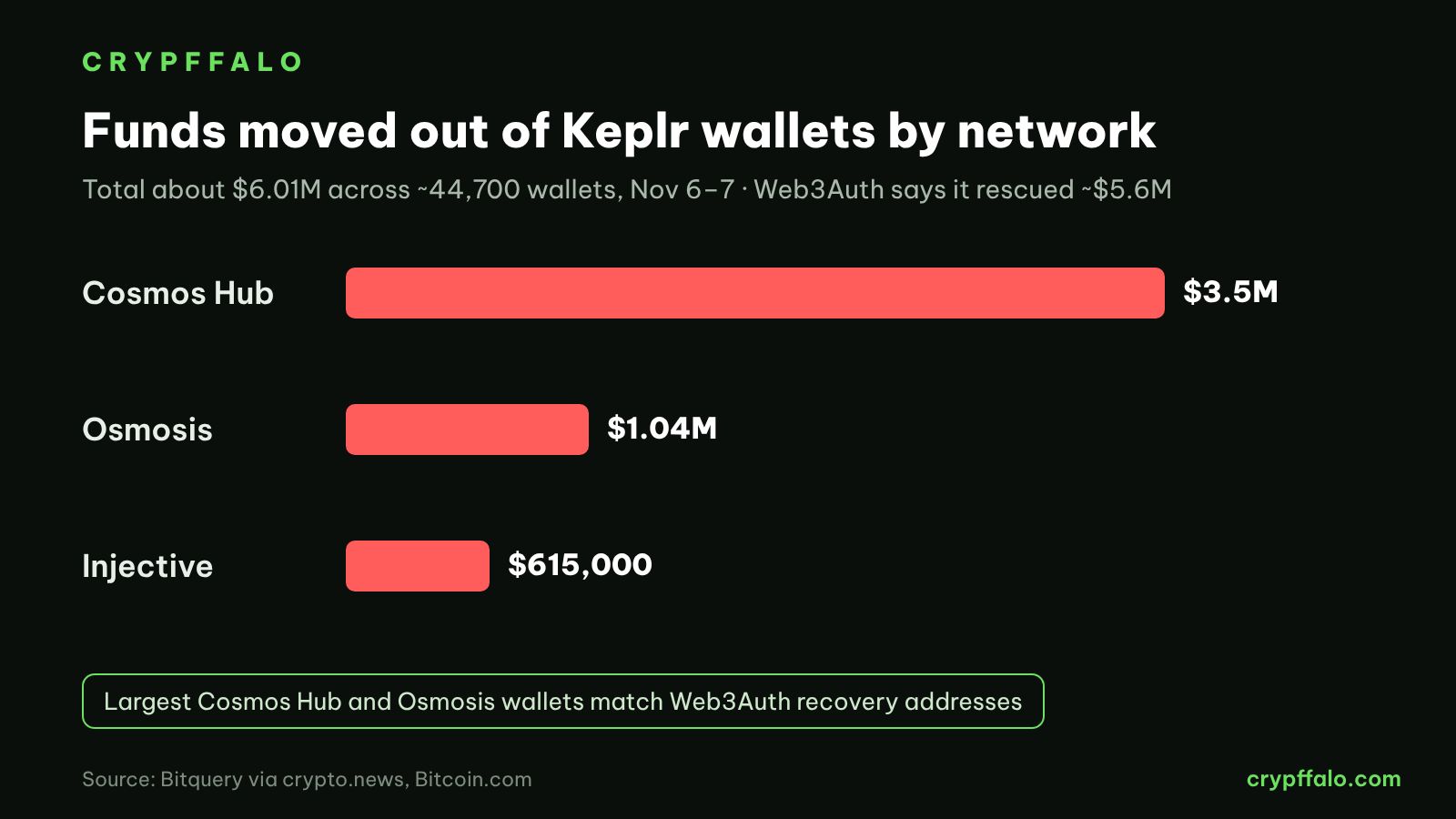
Bitquery tracked related addresses over Nov. 6–7 and recorded outflows on Cosmos Hub, Osmosis, Celestia, Akash, Noble, Babylon, dYdX and Injective. The main figures:
- Cosmos Hub: about $3.5 million.
- Osmosis: about $1.04 million.
- Injective: about $615,000.
- About 1.96 million staked ATOM moved without the usual 21-day unbonding period, using staking-share tokenization.
Most affected wallets held small balances, with a median loss of just $1.34 per wallet. The largest single transfer was close to $325,000.
Web3Auth front-runs the attackers
In its Nov. 8 update, Web3Auth published a list of verified recovery wallets across several Cosmos and EVM chains. The company acknowledged that some rescue transactions had been mistaken for attacker activity.
The two largest addresses flagged by Bitquery, a Cosmos Hub wallet with about $3.5 million and an Osmosis wallet with about $1.04 million, match Web3Auth's published recovery addresses. Still, Web3Auth referred to an "original attacker," suggesting some funds were in fact stolen.
Keplr warned that some Google and Apple accounts may show reduced or zero balances because of the rescue effort. Staked and locked assets will take longer to handle.
What it means for crypto markets
The incident is small next to recent major hacks and has had no clear impact on broader prices. Bitcoin traded flat around $75,800 over the weekend, while ATOM saw mild pressure.
- Bull case: Most funds are rescued in time, and Web3Auth publishes a clear root cause and return process, preserving trust in social-login wallets.
- Risk case: Actual theft proves larger than expected, or other apps using Web3Auth turn out to be affected, weighing on Cosmos ecosystem tokens.
The episode highlights the trade-off of one-tap wallets: easy onboarding, but reliance on a third party's key infrastructure. Users holding funds in Google or Apple-based wallets should follow official guidance from Keplr and Web3Auth.
What to watch next
- Web3Auth's full report on the root cause and the amount actually stolen.
- The account-check tool Keplr and Web3Auth are building.
- The plan to return rescued assets, especially staked positions.
- Whether other apps built on Web3Auth were affected.
- Broader market moves via real-time liquidations and the economic calendar.
Frequently Asked Questions
Is my Keplr wallet affected?
Only wallets created with Google or Apple logins are at risk. Wallets created with a seed phrase or a hardware wallet are not affected.
What does Keplr advise users to do?
Stop sending new funds to social-login wallets and move remaining liquid assets to a seed-phrase or hardware wallet. Rely only on official Keplr and Web3Auth channels.
Why does my wallet show a zero balance?
Your assets may have been moved to a Web3Auth recovery wallet for protection. Keplr and Web3Auth are building a tool so users can check their account status.
*This content is for information only and is not financial advice.*
Tags: Keplr, Web3Auth, Cosmos, Security
Related articles
- Bitcoin slides to $61,300, lowest since July, as liquidations top $600 million
- Sky's USDS sees $1.5B USDC exodus after North Korea-linked flows report
- Bitcoin tests $64,000 then slips as Anthropic opens 34% above its record IPO price
- Nvidia beats with $115.8B revenue, but Bitcoin barely moves near $64,500
- Solana Foundation takes majority stake in CoinGecko, eyes onchain trading
- Optimizely attack plants crypto address-swapping malware on 178 sites, including Ledger