Optimizely attack plants crypto address-swapping malware on 178 sites, including Ledger
Author: Crypffalo Research · 11:57 17/11/2026
Crypto address-swapping malware spread via Optimizely to 178 websites including Ledger; attackers collected about $7,000 in crypto before cleanup.

A malware campaign spread through website experimentation platform Optimizely planted crypto address-swapping code on the sites of 178 organizations, including hardware wallet maker Ledger. Security firm Report URI disclosed the findings at 22:47 UTC on Nov 16.
According to Report URI, the malicious code ran from 04:21 UTC on Nov 16 until late that evening, roughly 16 to 17 hours. About $7,000 in crypto reached the attacker's wallets, while losses from stolen cards and login cookies remain unknown.
Key takeaways
- Scale: 188 snippets belonging to 178 organizations were infected, out of 1,611 Optimizely snippets Report URI checked.
- Notable victims: Ledger, HSBC, IG, OANDA, Zoom, BBC, CNN and Salesforce; six were in crypto and trading.
- How it worked: it swapped BTC, ETH, Solana, TRON, TON and other wallet addresses, then added card, cookie and screenshot theft.
- On-chain losses: about $7,040 per Report URI and about $6,600 per StepSecurity.
- Status: nearly all code was removed by 21:52 UTC; Ledger's snippet was cleaned at 20:41 UTC.
How the code got in
Optimizely is an A/B testing tool that many large companies embed on their websites. Report URI said the attacker wrote code into the "Project JavaScript" field of customer projects, while the rest of each snippet still came from Optimizely's official CDN.
It is not yet clear how the attacker gained write access. DeFiPrime cited an Optimizely notice saying the company blocked the exploited path, removed the code and secured affected accounts.
What it did to crypto users
The main threat for crypto users was a "clipper": when someone copied or pasted a wallet address, the code replaced it with the attacker's. It validated checksums, so the fake address still looked valid on-chain.
How the attack escalated on Nov 16 (UTC):
- 04:21: first injection seen, on the BBC snippet.
- 13:43: a card skimmer was added to grab card numbers, expiry dates and CVVs.
- 17:13–17:57: exploit kits targeting iPhones on older iOS versions were added.
- 20:40–21:10: mass cleanup; by 21:52 only 1 of 188 snippets was still infected.
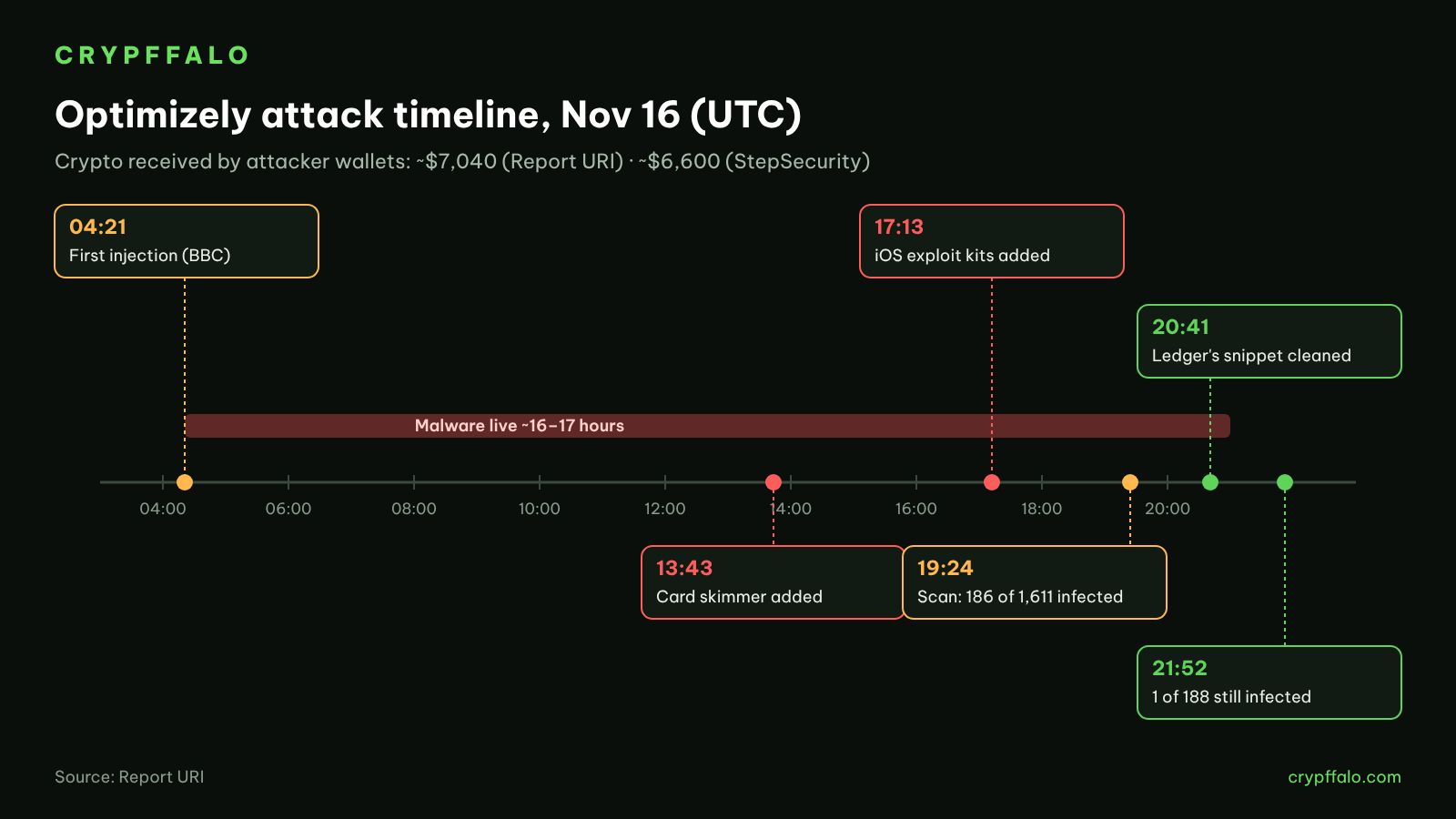
Report URI traced about 0.083 BTC (around $5,380) to the attacker's BTC wallet, with the rest in LTC, USDT on TRON, ETH and USDT on BSC. That is small for an attack of this reach, but card and cookie theft does not show up on-chain.
Shattered's analysis says the code lived on the website and did not touch Ledger's signing devices or private keys. None of the sources reviewed carried an official comment from Ledger.
Crypffalo data view
Crypffalo's DeepDom data for the 24 hours to 11:00 GMT+7 on Nov 17 shows Bitcoin trading almost flat as news of the attack spread.
- Price: BTC at $65,028.7, down 0.08% over 24 hours → a very tight range.
- Liquidations: $15.8 million in longs versus $27.6 million in shorts → shorts took more of the pain.
- Aggressive flows: futures net −$80.9 million, spot net +$92.6 million → sellers led on futures, buyers on spot.
- Order book ±1%: $166.4 million in bids versus $172.3 million in asks → slightly tilted to the sell side.
The data fits the view that this is a user-security incident rather than a price shock; see also real-time liquidations.
What it means for crypto markets
The incident has had little direct effect on prices, since on-chain losses were small and confined to one day. The main impact is on trust in the websites of crypto and finance brands.
- Bull case: the fast cleanup keeps losses in the thousands of dollars, and firms tighten third-party scripts on payment and wallet pages.
- Risk case: leaked cookies and card data fuel follow-up phishing, or more victims emerge beyond the 178 organizations.
The attack adds to a run of security incidents this week, including Lighter, Safe and Luxor, while market sentiment sits in extreme fear.
What to watch next
- A full report from Optimizely on the vulnerability and how many customers were affected.
- Responses from Ledger and the brokers and exchanges on the list.
- FOMC minutes and Nvidia earnings this week; see the economic calendar.
Frequently Asked Questions
Is my Ledger hardware wallet affected?
Analyses indicate the code ran on the website and did not reach devices or private keys. The risk was sending funds to a swapped address copied from an infected page on Nov 16.
What should I do if I visited an affected site on Nov 16?
Check the receiving address on your hardware wallet screen before signing, log out of exchange sessions and watch your card statements. iPhone users should update to iOS 18.7.3 or 26.3 or later.
How much crypto did the attacker take?
Roughly $6,600 to $7,040 depending on the source, mostly in BTC. Losses through cards and cookies have not been disclosed.
*This content is for information only and is not financial advice.*
Tags: Security, Ledger, Malware, Crypto wallets
Related articles
- Sky's USDS sees $1.5B USDC exodus after North Korea-linked flows report
- Bitcoin tests $64,000 then slips as Anthropic opens 34% above its record IPO price
- Nvidia beats with $115.8B revenue, but Bitcoin barely moves near $64,500
- Solana Foundation takes majority stake in CoinGecko, eyes onchain trading
- Zelle picks Solana for ZelleUSD stablecoin in cross-border payments push
- Lighter halts withdrawals after leaked API key drains $10.4 million