DOJ moves to seize $1.2 billion from Binance hack, disrupts North Korean deepfake ring
Author: Crypffalo Research · 05:54 13/11/2026
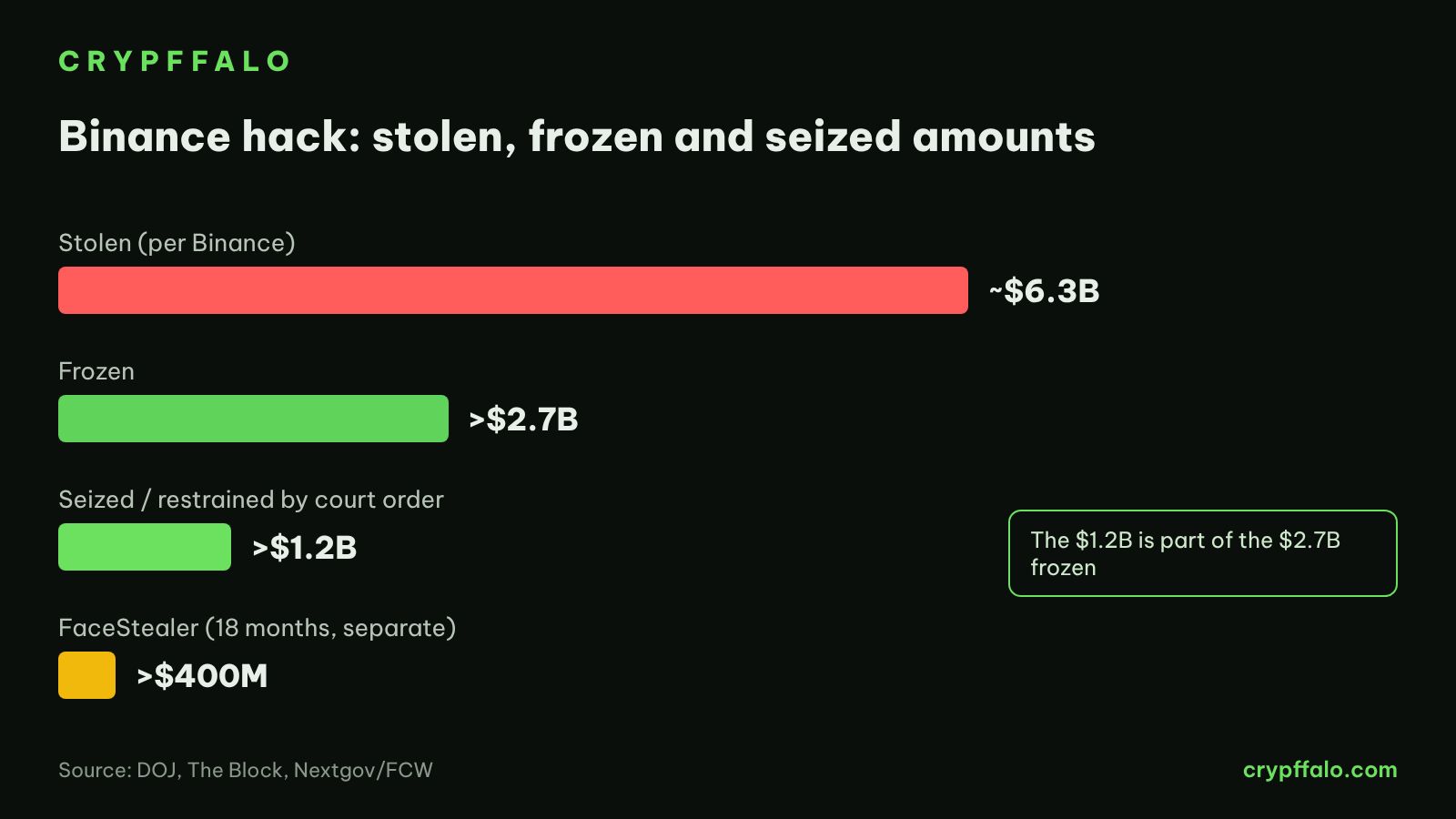
The U.S. Justice Department says it has seized or restrained more than $1.2 billion stolen in the Binance hack, with over $2.7 billion frozen in total. The FBI also took down infrastructure behind FaceStealer, a scheme tied to $400 million in theft.

The U.S. Justice Department said it has seized or restrained, under court orders, more than $1.2 billion in crypto stolen in Binance's late-October hack. The announcement came on Thursday afternoon U.S. time, around 4:40 a.m. on Nov 13 in GMT+7.
Alongside it, the FBI took down infrastructure behind FaceStealer, a North Korean scheme that uses fake video calls. Prosecutors say the operation stole more than $400 million over the past 18 months.
Key takeaways
- Seized: More than $1.2 billion from the Binance hack has been seized or restrained by court order and is now in U.S. government custody.
- Frozen: Public and private efforts have frozen over $2.7 billion in total; the $1.2 billion is part of that figure.
- Attribution: The DOJ ties the Oct 29 hack to North Korean military hackers the FBI tracks as TraderTraitor.
- FaceStealer: The FBI seized cloud infrastructure and more than 900 victim webcam videos linked to over $400 million in theft.
- Still unclear: Which tokens and chains are involved, and how funds would be returned to Binance.
The Binance hack and the chase for the funds
Binance was hit on or about Oct 29. The exchange put its loss at about $6.3 billion, while the DOJ described the haul as "more than $6 billion."
Last week the FBI issued an alert attributing the theft to North Korea. It urged virtual asset service providers to block transactions linked to the laundering addresses.
According to the DOJ, investigators froze a large share of the assets before they moved out of reach. The department said roughly half of the breach was halted right away.
A senior DOJ official told reporters the government now holds the funds covered by the court orders. Returning them would generally require court proceedings on ownership, and the official said it is too early to say how that will work.
Binance says it has completed coverage of the affected assets. The exchange also published a fresh proof-of-reserves snapshot on Nov 12.
FaceStealer: theft by fake video call
The DOJ says the hackers invite targets to video meetings from accounts hijacked from earlier victims. They play prerecorded clips of a known contact or deepfakes of well-known crypto figures.
The attackers then fake an audio glitch and offer a "fix" that installs malware. Invites arrive via Telegram, LinkedIn, Slack or Discord, and the meeting pages mimic Zoom or Microsoft Teams.
In some cases the account takeover came months, or more than a year, after the first compromise. The group is also increasingly targeting open-source developers, apparently for software supply-chain attacks.
Arctic Wolf, a security firm assisting the FBI, said it has identified more than 677 targets in 58 countries. Officials believe FaceStealer and TraderTraitor are likely different North Korean groups.
Crypffalo data view
Crypffalo's DeepDom data for the 24 hours to 5:00 a.m. GMT+7 on Nov 13 shows selling pressure still in control, with no clear reaction to the seizure news yet:
- Price: BTC at $71,536, down 3.8% over 24 hours; BNB at $654.6, down 4.55% → BNB underperformed BTC.
- Liquidations: $101.1 million of BTC longs were liquidated versus just $5.8 million of shorts → longs took most of the damage (real-time liquidations).
- Aggressive flows: BTC net futures flow was -$1.28 billion and net spot flow -$117.1 million; BNB net futures flow was -$34.5 million → sellers dominated futures.
- Order book ±1%: BTC showed $231.6 million in bids against $196.9 million in asks → the book leaned slightly toward buyers.
These figures mostly capture the slide after the Nvidia news and ETF outflows, since the window closed almost exactly when the DOJ announcement landed.
What it means for crypto markets
The seizure does not immediately change the price picture, which is being driven by tech stocks and ETF flows. It does, however, ease part of the worry about billions in stolen funds being dumped on the market.
- Bull case: Blocking roughly $2.7 billion shows improving coordination between U.S. agencies and industry, which supports confidence in large exchange infrastructure.
- Risk case: The remaining $3 billion-plus is still being laundered through bridges, mixers and exchanges; large transfers could add local selling pressure.
FaceStealer is also a reminder that the biggest risk often sits with people rather than code, even at an exchange the size of Binance.
What to watch next
- Whether the DOJ files a civil forfeiture complaint and discloses which assets it holds.
- The return process for Binance and the share of funds still untraced.
- New FBI alerts on laundering wallets tied to the hack.
- Bitcoin ETF flows and tech stocks; see the economic calendar.
Frequently Asked Questions
Is the $1.2 billion on top of the $2.7 billion frozen?
No. According to the DOJ, the $1.2 billion seized or restrained by court order is part of the more than $2.7 billion frozen overall.
Are Binance users affected?
Binance says it has fully covered affected assets with company funds and published a new proof-of-reserves snapshot on Nov 12.
How can people avoid a FaceStealer-style scam?
The FBI advises against installing any "fix" sent during a video call and verifying the caller through a separate channel before acting.
*This content is for information only and is not financial advice.*
Tags: Binance, Hack, North Korea, DOJ
Related articles
- Bitcoin slides to $61,300, lowest since July, as liquidations top $600 million
- Sky's USDS sees $1.5B USDC exodus after North Korea-linked flows report
- Bitcoin tests $64,000 then slips as Anthropic opens 34% above its record IPO price
- Nvidia beats with $115.8B revenue, but Bitcoin barely moves near $64,500
- Solana Foundation takes majority stake in CoinGecko, eyes onchain trading
- Optimizely attack plants crypto address-swapping malware on 178 sites, including Ledger