Bitcoin ETFs See $643M Outflow, Largest Since June After Binance Hack
Author: Crypffalo Research · 19:54 31/10/2026
US spot bitcoin ETFs bled $643.2 million on Oct 30 after the Binance hack, erasing four days of inflows, while ether ETFs lost another $155.7 million.

US spot bitcoin ETFs saw $643.2 million in net outflows on Friday, Oct 30, according to Farside data cited by crypto.news and TokenPost. It was the heaviest single-day withdrawal since late June.
The reversal came a day after Binance confirmed a roughly $6.3 billion hack. Spot ether ETFs lost another $155.7 million, bringing combined outflows across the two groups to nearly $799 million.
Key takeaways
- Headline number: Bitcoin ETFs shed $643.2 million on Oct 30, while ether ETFs lost $155.7 million.
- Biggest losers: BlackRock's IBIT saw about $233.7 million leave, and Fidelity's FBTC about $201 million.
- Weekly picture: Four days of inflows worth $440.8 million were wiped out, leaving the Oct 26–30 week at -$202.4 million.
- Backdrop: The Binance hack, a tech-stock selloff and bitcoin slipping to around $77,000.
- Long view: Cumulative net inflows into bitcoin ETFs since January 2024 still stand near $57 billion.
Outflows by fund
According to Farside's table, no bitcoin fund posted an inflow on Oct 30. The three largest funds accounted for almost 88% of the day's outflow.
- IBIT (BlackRock): about -$233.7 million
- FBTC (Fidelity): about -$201 million
- ARKB (Ark/21Shares): -$129.5 million
- GBTC (Grayscale): -$53.3 million
- BITB (Bitwise): -$25.7 million
The outflow topped the Oct 22 session (about -$635.6 million) and trails only June 25 (about -$691.7 million) this year. IBIT still finished the week with roughly $176.9 million in net inflows thanks to its strong start.
A week undone in one session
Before Friday, bitcoin ETFs had strung together four straight days of inflows. Here is how the week played out:
- Oct 26: +$110.3 million
- Oct 27: +$176 million
- Oct 28: +$137.3 million
- Oct 29: +$17.2 million
- Oct 30: -$643.2 million
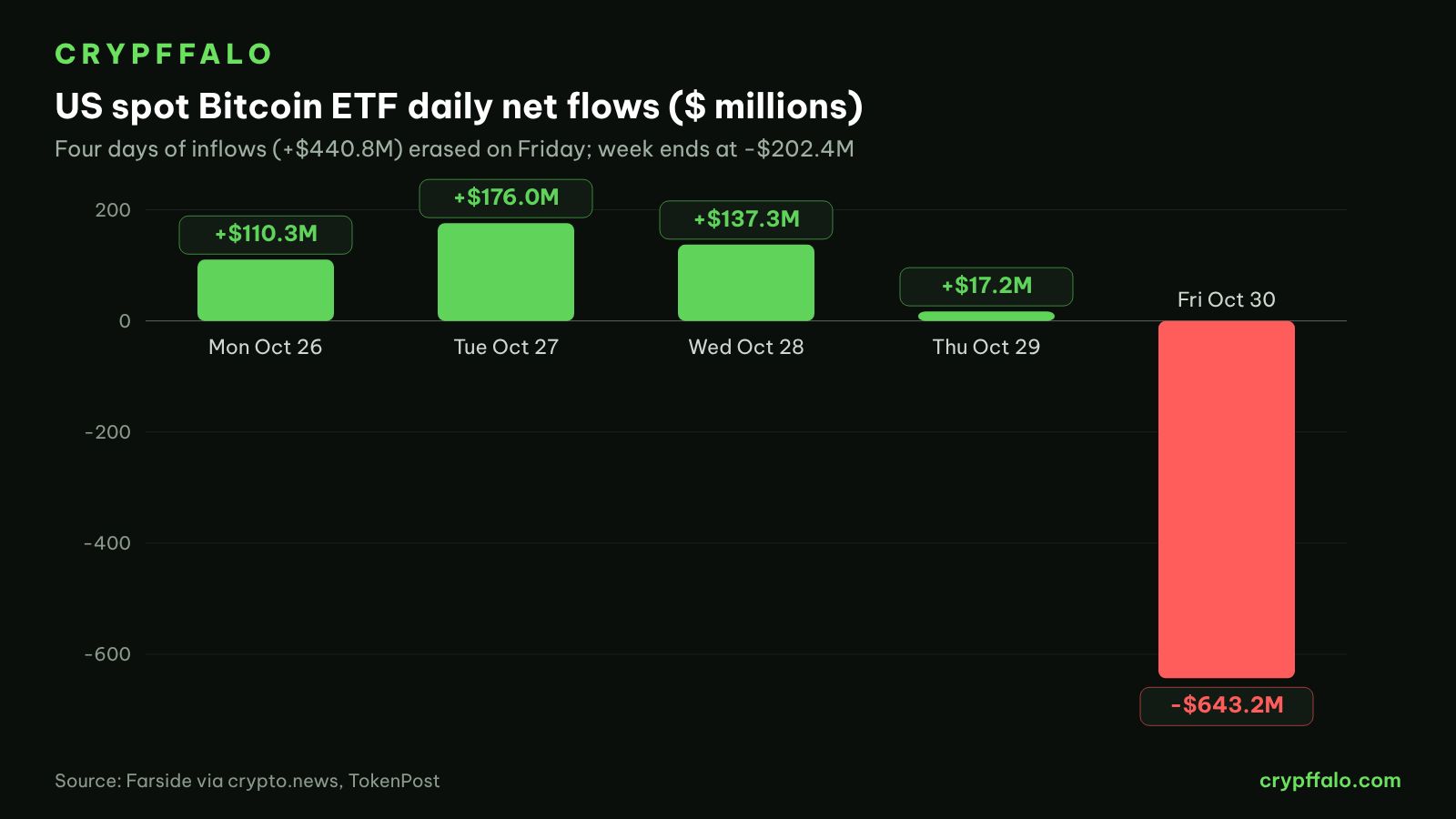
Inflows had already slowed to a trickle on Thursday, just as news of the Binance incident began to spread. After Friday, bitcoin ETFs swung to roughly $515.9 million in net outflows for October.
Ether funds looked weaker still. Spot ether ETFs bled money in all five sessions of the week, about $431.4 million in total, and have lost roughly $1.6 billion in October.
Why investors pulled money
Pressure came from several directions at once. The Binance hack revived institutional worries about exchange infrastructure risk, even though Binance said it had set aside more than $6.34 billion of company funds to cover losses.
On the same day, US tech stocks came under pressure as Intel shares plunged and fears over AI spending spread. Bitcoin hit a 24-hour low near $76,338 before recovering to around $77,200–$77,400 early on Oct 31 UTC.
Glassnode data puts the average cost basis of ETF buyers near $81,500. At current prices, many recent ETF buyers are sitting on paper losses, which could add selling pressure if sentiment sours further.
What it means for crypto markets
A $643 million outflow day is a clear sign of caution, but it is not a stampede. The figure is only about 1% of the roughly $57 billion in cumulative net inflows the funds have gathered.
- Bull case: Binance reopens withdrawals smoothly and publishes proof-of-reserves on schedule, steadying sentiment and bringing ETF demand back like earlier in the week.
- Risk case: Outflows persist for several sessions while bitcoin breaks the $75,000–$77,000 support zone flagged by Compass Point, potentially triggering more leveraged liquidations.
Wall Street firms including Cantor Fitzgerald and TD Cowen argue the hack does not threaten bitcoin's underlying technology. Even so, institutional money tends to react quickly to bad news and take time to return.
What to watch next
- Nov 1: Binance aims to restore withdrawals in phases after security checks.
- Nov 2: Binance plans to publish proof-of-reserves data.
- Monday, Nov 2 session: Whether bitcoin and ether ETF flows stay negative.
- Next week: US jobs data and Fed rate expectations; check the economic calendar.
- Leverage: Keep an eye on real-time liquidations if prices swing sharply.
Frequently Asked Questions
Is the $643 million outflow a record?
No. It is the largest since June 25 (about -$691.7 million), according to Farside data.
Why is IBIT still positive for the week despite heavy outflows?
IBIT drew about $410.6 million over the first four days of the week. After Friday's $233.7 million outflow, it still ended the week with roughly $176.9 million in net inflows.
How do ETF flows affect the bitcoin price?
When investors redeem shares, issuers typically sell the bitcoin they hold, adding pressure to the spot market. The effect is stronger when outflows last several sessions.
*This content is for information only and is not financial advice.*
Tags: Bitcoin, ETF, BlackRock, Binance, Fund Flows
Related articles
- Trump says US looking into Binance hack as CFTC chair pushes offshore oversight
- Binance targets Nov 1 withdrawal restart after finding more breach points in $6.3B hack
- Crypto stocks slide: Coinbase drops 12%, Strategy 11% as Binance hack weighs
- Binance sets aside $6.34 billion in corporate funds to cover hack losses
- Bitcoin Falls Below $77,000 as Binance Hack Triggers $1.5B in Liquidations
- Binance confirms $6.3 billion hack as analysts point to North Korea's Lazarus