Trump says US looking into Binance hack as CFTC chair pushes offshore oversight
Author: Crypffalo Research · 05:53 31/10/2026
Trump said the administration is looking into the $6.3 billion Binance hack, including possible North Korean involvement, as CFTC Chairman Michael Selig urged U.S. oversight of offshore exchanges.

President Donald Trump said his administration is looking into the $6.3 billion hack of Binance, including whether North Korean hackers were behind it. He made the remarks at the White House on Friday, Oct 30 (early Oct 31, GMT+7).
On the same day, CFTC Chairman Michael Selig said the breach "proves our exact point" that offshore crypto exchanges need U.S. oversight and cybersecurity standards. The story is shifting from a technical incident to a policy fight.
Key takeaways
- White House: Trump said he does not know whether North Korea was responsible, but the administration is "looking into it."
- CFTC: Selig pitched a "federal option" letting offshore venues register with the CFTC under U.S.-grade security rules.
- Investigation: The FBI and Secret Service are working with private partners, including Circle, to trace and freeze funds.
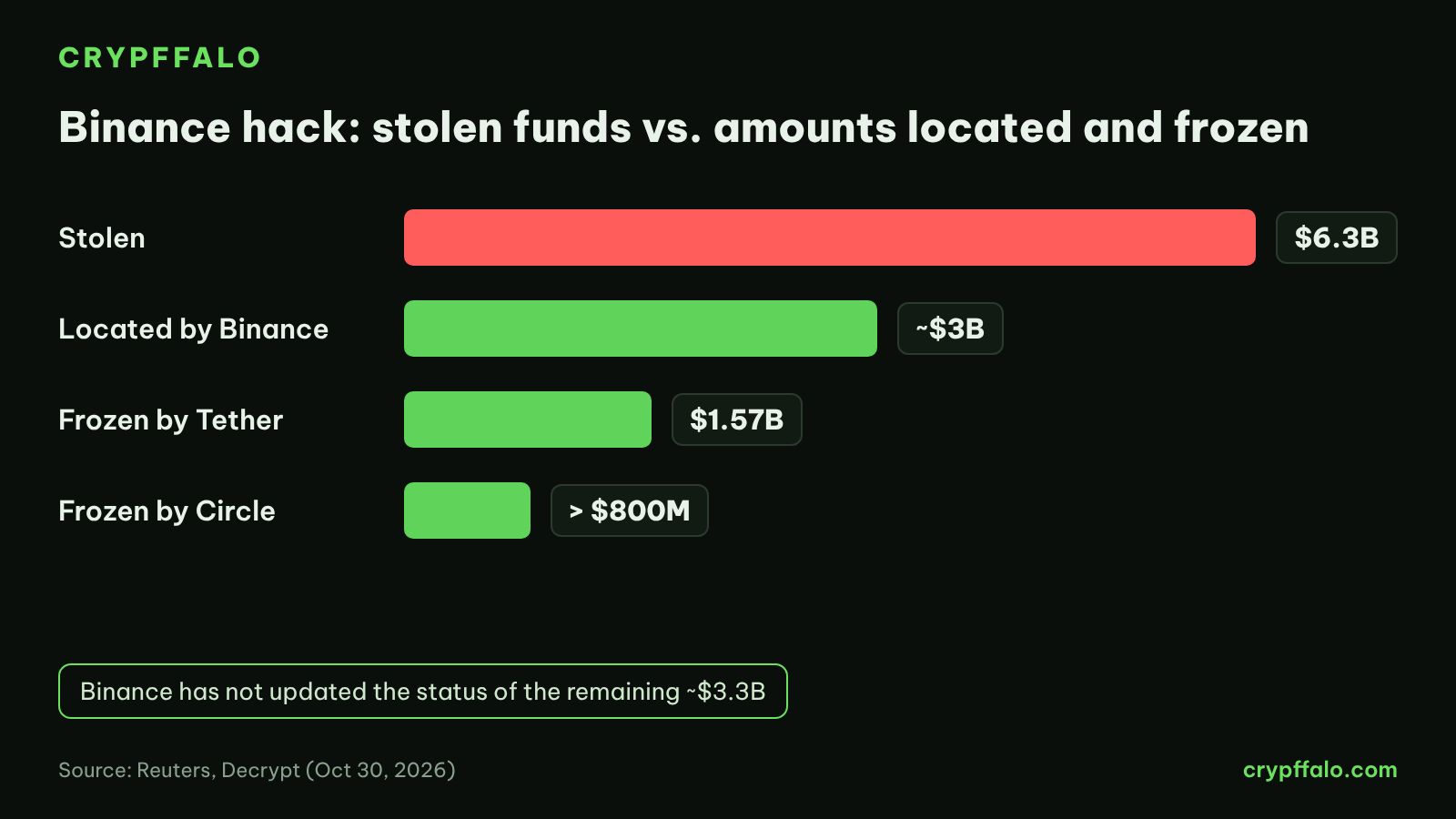
- Frozen funds: Binance says about $3 billion has been located; Tether froze nearly $1.57 billion and Circle more than $800 million.
- Markets: Bitcoin trades around $76,400–$76,900, while BNB is down about 6% over 24 hours.
Washington weighs in
Asked whether stolen funds could be recovered, Trump called hacking "the problem," saying that with digital money "people never see the money anymore." He added that he had always felt the space was "a little bit dangerous."
He also said Binance told officials it has the situation "pretty much under control." It is the first direct comment on the incident from the president.
On the enforcement side, the FBI said it is engaged with public and private partners to understand the scope of the attack. The Secret Service said investigators are working "around the clock" with Circle to identify, freeze, trace and recover the stolen funds.
CFTC uses the hack to push its rulebook
Speaking to CNBC, Selig said the core issue is that offshore exchanges are unregulated and lack the safeguards of U.S. markets. He wants such venues to be able to register with the CFTC and meet the same cybersecurity standards.
Selig also stressed that Ethereum itself was not broken. In his view, the vulnerability was likely "introduced from someone's laptop," the kind of incident that also hits traditional finance.
That framing may be incomplete. Binance co-CEO Richard Teng later described "a more complex attack process" that went beyond one engineer's permissions and included malware designed to erase its own tracks.
The policy backdrop matters:
- The CFTC has sent the White House proposals that would classify event contracts as swaps.
- The agency is drafting its own framework for crypto exchange oversight rather than waiting on Congress.
- The Clarity Act, the main crypto market structure bill, remains stalled in the Senate.
Where the stolen money is
Binance says it has located about $3 billion of the $6.3 billion taken, without giving an update on the remaining $3.3 billion. Co-CEO Yi He said $3 billion equals only about 2% of total user assets and public reserves.
Binance is targeting a restart of withdrawals within roughly 34 hours of Friday afternoon U.S. Eastern time. It also plans an initial proof-of-reserves snapshot, with results expected on Monday, Nov 2.
What it means for crypto markets
Bitcoin hit a six-week low of $76,368 before stabilizing, while ether slipped to around $2,178. The price reaction has stayed relatively orderly compared with the panic around FTX's 2022 collapse.
- Bull case: An on-time withdrawal restart, a clean proof-of-reserves report and more funds frozen could help sentiment recover gradually.
- Risk case: A delayed restart, or faster moves in Washington against offshore venues, could pull liquidity from centralized exchanges and weigh on BNB and BTC.
Bitwise CIO Matt Hougan noted that hot wallet hacks, even large ones, have historically had little lasting impact on crypto returns. Still, the market is also contending with high U.S. rates and softer ETF demand.
What to watch next
- Binance's withdrawal restart, expected around Nov 1.
- Binance's proof-of-reserves results, expected Monday, Nov 2.
- An official FBI attribution regarding North Korea.
- Further CFTC steps on offshore exchanges.
- Track leverage stress on our real-time liquidations page and macro dates on the economic calendar.
Frequently Asked Questions
Can U.S. regulators oversee Binance?
Binance's main operating license comes from Abu Dhabi's Financial Services Regulatory Authority. The CFTC proposal is an option for offshore venues to register in the U.S., not a binding rule yet.
Has North Korea been confirmed as the attacker?
There is no official U.S. government attribution yet. TRM Labs and Chainalysis have linked the theft to North Korea's TraderTraitor group, and Trump said the administration is looking into it.
Will Binance users lose money?
Binance has pledged to cover all losses with about $6.34 billion of company funds. That will become clearer once withdrawals reopen and the proof-of-reserves results are published.
*This content is for information only and is not financial advice.*
Tags: Binance, CFTC, Regulation, Hack
Related articles
- Binance targets Nov 1 withdrawal restart after finding more breach points in $6.3B hack
- Crypto stocks slide: Coinbase drops 12%, Strategy 11% as Binance hack weighs
- Binance sets aside $6.34 billion in corporate funds to cover hack losses
- Bitcoin Falls Below $77,000 as Binance Hack Triggers $1.5B in Liquidations
- Binance confirms $6.3 billion hack as analysts point to North Korea's Lazarus
- Binance Halts Withdrawals on Several Networks After Suspected Hack; CZ Expects Full Cover