Stablecoin supply shrinks $14.2B in 30 days, a pace unseen since 2022 bear market
Author: Crypffalo Research · 03:56 12/11/2026
Major stablecoin supply fell $14.2 billion over 30 days, a contraction not seen since the 2022 bear market, per Glassnode, as USDT and USDC shed nearly $11 billion.

Supply of the major stablecoins has fallen by roughly $14.2 billion over the past 30 days, according to a Glassnode report published on Nov 11. That is a pace of contraction not seen since the 2022 crypto bear market.
USDT and USDC alone shed nearly $11 billion of supply in the month. Total stablecoin market capitalization now sits just below $280 billion, a level last seen in September 2025, according to The Block's data compiled from DefiLlama.
Key takeaways
- Headline figure: major stablecoin supply dropped $14.2 billion in 30 days (Glassnode).
- The big two: USDT and USDC together lost nearly $11 billion over the past month.
- USDT: market cap fell $6.6 billion in the 60 days to Nov 7, more than double the $3.2 billion drop after FTX in late 2022 (CryptoQuant).
- Total market: just under $280 billion, a level last seen in September 2025.
- Price backdrop: bitcoin hovers near $74,000 as spot bitcoin ETFs log a fourth straight day of outflows.
Why stablecoin supply matters
Stablecoins are the cash layer of crypto, used to buy tokens on exchanges and to post collateral for derivatives. Growing supply usually means more dry powder waiting on the sidelines; shrinking supply means holders are redeeming for dollars and pulling money out.
Glassnode said the contraction leaves less buying power for any rebound. The decline comes as bitcoin struggles below $75,000 after several weeks of losses, The Block noted.
How it compares with 2022
The last time stablecoins drained this quickly was mid-2022. Key reference points:
- June 2022: stablecoin supply fell nearly $30 billion over 30 days in the wake of Terra's collapse.
- November 2022: bitcoin bottomed near $15,500, about five months after that drawdown.
- December 2022: USDT's market cap fell $3.2 billion over 60 days following FTX's collapse.
- Sept–Nov 2026: USDT down $6.6 billion over 60 days; major stablecoins down $14.2 billion over 30 days.
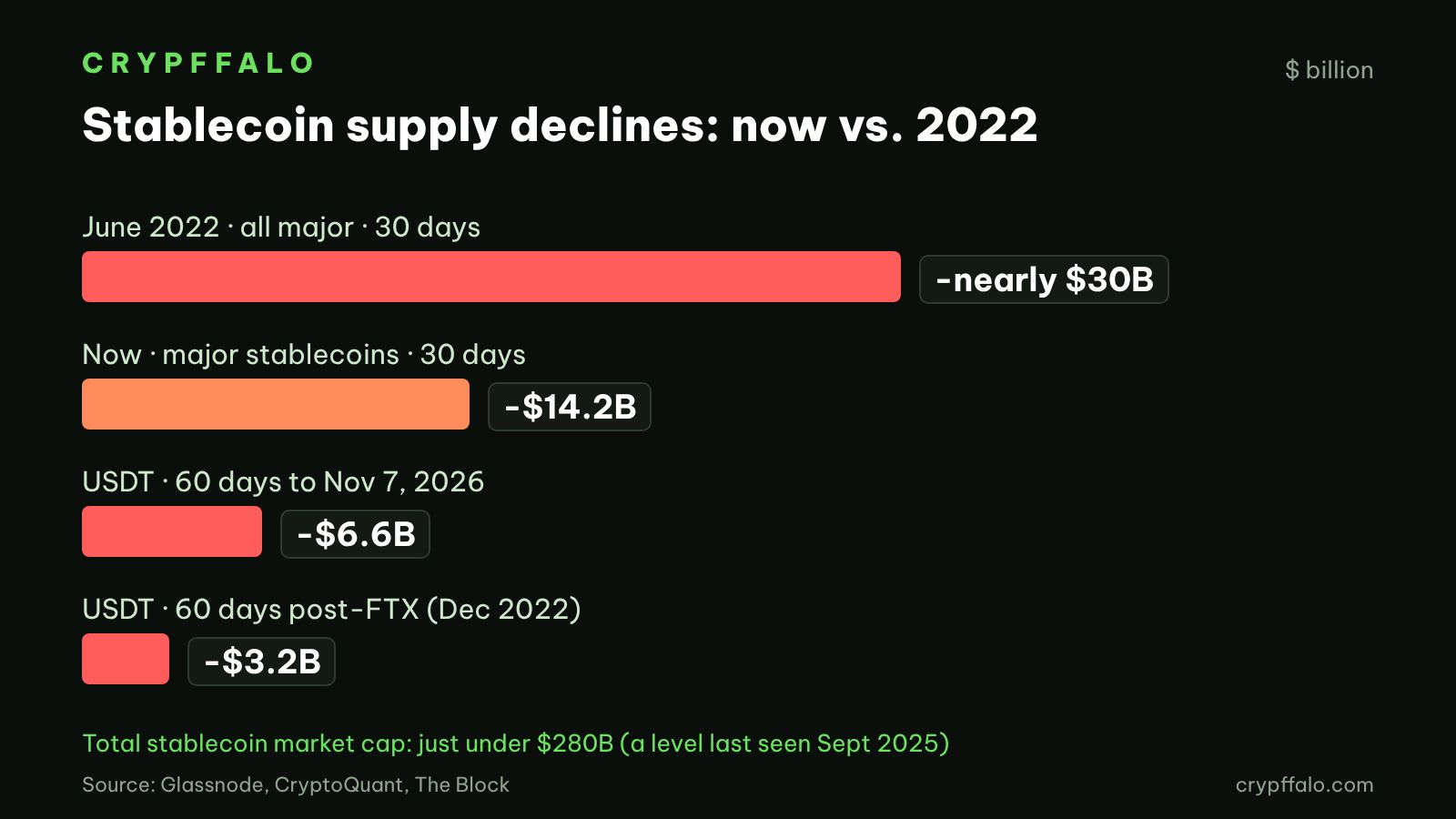
The current drawdown is still about half the size of June 2022, but USDT's pace of redemptions has already outrun the post-FTX period. CryptoQuant said a local bitcoin bottom could form before USDT supply turns positive again.
By market share, USDT still accounts for about 62.8% of stablecoin supply and USDC about 25.1%, according to The Block.
Crypffalo data view
Crypffalo's DeepDom data for the 24 hours to 3:00 a.m. GMT+7 on Nov 12 shows a modest bitcoin bounce, but spot flows did not follow futures:
- Price: BTC at $74,381, up 1.29% over 24 hours → a small rebound after a run of losses.
- Liquidations: $20.5 million in shorts versus just $5.2 million in longs → short sellers took most of the pain.
- Aggressive flows: futures saw $306.7 million in net taker buying, while spot showed $8.4 million in net selling → buying concentrated in derivatives, spot leaned slightly to sellers.
- Order book ±1%: $182.3 million in bids versus $207.5 million in asks → the book tilted toward sellers.
Weak spot flows and an ask-heavy book fit the story of thinning stablecoin cash; by contrast, the strong futures buying suggests the past day's bounce was largely leverage-driven. See more on DeepDom and real-time liquidations.
What it means for crypto markets
A shrinking stablecoin base does not push prices down by itself, but it reduces the cash ready to buy into rallies. It also coincides with multi-day ETF outflows and a hotter-than-expected October CPI print in the U.S.
- Bull case: redemptions slow and USDT supply starts growing again, signaling fresh capital; CryptoQuant suggests a local bottom could even come before that.
- Risk case: supply keeps contracting while ETF outflows continue, leaving rallies dependent on futures leverage and prone to reversal.
Part of the redeemed supply may be rotating into other products such as tokenized Treasury funds, so the figure does not map one-to-one onto money leaving crypto.
What to watch next
- Weekly USDT and USDC supply, especially large mints or burns by Tether and Circle.
- Spot bitcoin ETF flows and whether the four-day outflow streak ends.
- Upcoming U.S. data on the economic calendar after October CPI rose 0.4%.
- Long/short liquidation swings on real-time liquidations.
Frequently Asked Questions
What does falling stablecoin supply mean?
It means more stablecoins are being redeemed for dollars (burned) than newly issued. It usually signals cash leaving the crypto market.
Is the $14.2 billion drop as large as in 2022?
Not yet: in June 2022 supply fell nearly $30 billion over 30 days. Still, Glassnode says this is a contraction not seen since that period.
How much of the market does USDT hold?
According to The Block, USDT holds about 62.8% of total stablecoin supply and USDC about 25.1%.
*This content is for information only and is not financial advice.*
Tags: Stablecoins, USDT, USDC, Bitcoin, Liquidity
Related articles
- Bitcoin slides to $61,300, lowest since July, as liquidations top $600 million
- Sky's USDS sees $1.5B USDC exodus after North Korea-linked flows report
- Bitcoin tests $64,000 then slips as Anthropic opens 34% above its record IPO price
- Nvidia beats with $115.8B revenue, but Bitcoin barely moves near $64,500
- Solana Foundation takes majority stake in CoinGecko, eyes onchain trading
- Fed's Musalem sees several rate hikes by spring 2027 as US retail sales beat forecasts