Robinhood Chain After the Crash: What UNI and ORDI Cycles Say About PONS, HOOKR
Author: Crypffalo Research · 21:33 25/10/2026
PONS is down 77% and HOOKR 57% from their peaks as Robinhood Chain activity cools. We compare DeFi Summer 2020 and 2023 inscriptions to map out a possible second wave for tax tokens.

Robinhood Chain, the layer-2 network built by Robinhood, has just gone through its first crash after the summer 2026 memecoin frenzy. Leading token PONS is down about 77% from its $0.974 peak, while HOOKR has dropped roughly 57% in little more than a week.
The question for many traders is whether the sell-off is nearly done or only getting started. This analysis compares Robinhood Chain with two similar cycles, DeFi Summer 2020 and the 2023 inscriptions wave, to map out possible scenarios.
Key takeaways
- Current state: Daily gas fees on Robinhood Chain fell 99.6%, from $8.4 million on Sep 4 to about $34,000 on Oct 18.
- 2020 lesson: UNI fell about 81% ($9.5 to $1.8), based for roughly three months, then rallied nearly 25x to $45.
- 2023 lesson: ORDI fell close to 90% ($29 to $3), moved sideways for about five months, then climbed roughly 30x to $95.
- Thesis: Tax tokens combined with Uniswap v4 hooks could be a third new token distribution model, after yield farming and fair launches.
- Risks: Two cycles are a tiny sample, and many tokens launched alongside UNI and ORDI went to near zero with no second wave.
What is Robinhood Chain and what just happened?
Robinhood Chain is an Ethereum layer-2 built on the Arbitrum Orbit stack, with its public mainnet live since July 1, 2026. Robinhood pitched it as a home for tokenized stocks, but early capital flowed mostly into memecoins and launchpads.
Activity peaked in late August and early September. Once the 90-day gas subsidy ended on Sep 29, on-chain activity cooled noticeably.
According to data compiled by TokenPost and AMBCrypto:
- Daily gas fees dropped from $8.4 million (Sep 4) to about $34,000 (Oct 18).
- Average daily DEX volume fell from roughly $173 million to $8.95 million.
- Pons V2 fee revenue over 14 days slid from $87 million to $7 million.
- The median memecoin on the chain sits about 97% below its peak, and about 72% of memecoins are down at least 90%.
The chain is not dead, though. It still logged about 873,000 active wallets in the latest week, and roughly $480 million sits in two Morpho stablecoin lending markets.
Lesson one: DeFi Summer 2020 and UNI
In 2020, yield farming introduced a new way to distribute tokens: users earned them by providing liquidity instead of buying from venture funds. That wave arrived early in a bull market.
After the first boom, UNI slid from about $9.5 to $1.8, a drop of roughly 81%. It then based for around three months before a second wave carried it to about $45 in May 2021.
UNI was not alone. SUSHI fell about 95%, from $11.2 to $0.5, before rallying to around $23.4, or nearly 47x from the low. YFI and CAKE also suffered drops of more than 90% before multiplying in value.
Lesson two: inscriptions 2023 and ORDI
In 2023, inscriptions brought the fair-launch model: anyone could mint, and no fund held a large, cheap allocation. This, too, came early in a bull cycle.
ORDI dropped from about $29 (May 2023) to $3, a decline of close to 90%. It then traded sideways for about five months, right as the crowd declared that "inscriptions are dead."
Within roughly three months after that, ORDI climbed about 30x to $95. SATS, a sister token, gained by a factor of several hundred.
The two cycles side by side:
- New distribution model: UNI rode yield farming; ORDI rode a VC-free fair launch.
- Drawdown from the wave-1 peak: about −81% for UNI, about −90% for ORDI.
- Basing period: about three months for UNI, about five months for ORDI.
- Wave-2 gain from the low: roughly 25x for UNI, roughly 30x for ORDI.
Tax tokens and Uniswap v4 hooks: a third distribution model?
In 2026, Robinhood Chain is testing a mix of stock/meme trading pairs, fair launchpads and Uniswap v4 hooks. If it works, it could lay the groundwork for a "DeFi 2.0 Summer." The thesis rests on four pillars.
- Stocks meet memecoins: Stocks are familiar to traditional investors, while memecoins are native to crypto. Pairing them gives both crowds an easy, shareable story.
- A trading tax funds the ecosystem: Every buy or sell pays a small fee, split among the team, the token creator, traders and the launchpad. Projects get operating money from day one without VC funding.
- v4 hooks keep the toll booth open: Fee capture used to disappear once a token graduated from its launchpad. Uniswap v4 hooks let it persist for the token's entire lifetime.
- Buyback and burn: All tokens circulate from the start, with no large locked supply waiting to unlock. Fees and product revenue fund buybacks and burns, much like a company repurchasing its own shares.
For example, KuCoin reports that the Hookr.fun launchpad lets creators name up to four fee recipients. On ETH-paired launches, a 0.3% protocol fee goes to a contract that buys back and burns HOOKR.
The catch is that the loop runs both ways. When volume shrinks, fees fall, buyback pressure weakens and price can come under further strain.
To be sustainable, the model needs richer base infrastructure, deeper liquidity from both RWAs and crypto, and support programs from Robinhood Chain for builders and users. If those conditions come together, a second leg higher would have a firmer footing.
Where PONS and HOOKR stand versus past cycles
The early phase of this wave produced leading tokens such as PONS and AI, alongside projects like HOOKR and HYDX. As of Oct 25, 2026, PONS is down about 77% from its $0.974 peak on Sep 5, close to UNI's 2020 drawdown.
HOOKR is only about 57% below its $0.0361 peak from Oct 16. That is still well short of the lows seen in earlier cycles.
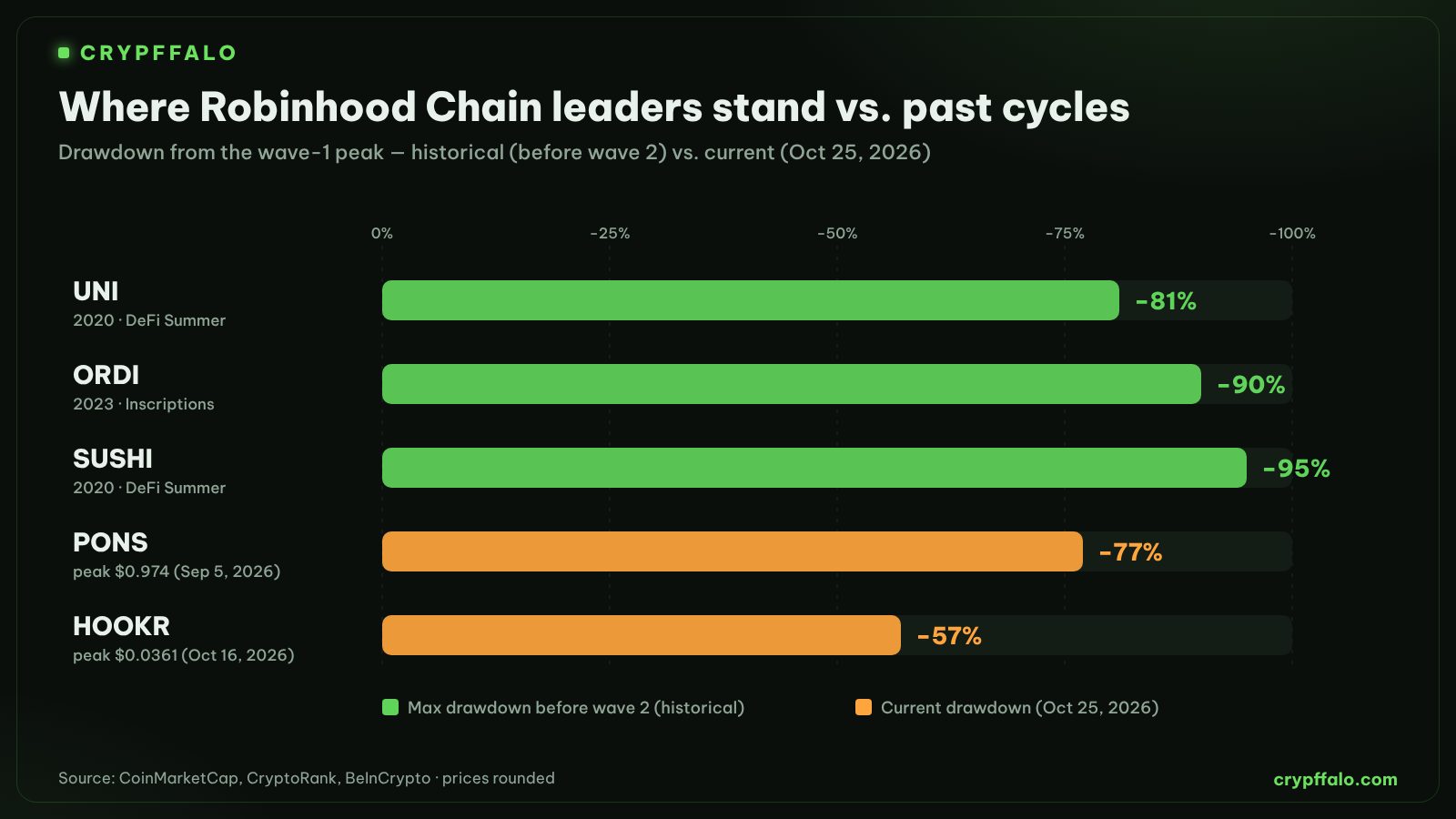
If both tokens retrace the exact path of UNI or SUSHI, the hypothetical levels look like this (current prices: PONS $0.224, HOOKR $0.0155):
- PONS, UNI-style: bottom near $0.185 (another 17% down), wave-2 peak near $4.63 (+1,960% from today).
- PONS, SUSHI-style: bottom near $0.049 (another 78% down), wave-2 peak near $2.29 (+920%).
- HOOKR, UNI-style: bottom near $0.0069 (another 56% down), wave-2 peak near $0.172 (+1,000%).
- HOOKR, SUSHI-style: bottom near $0.0018 (another 88% down), wave-2 peak near $0.085 (+450%).
Notably, the SUSHI-style path yields less upside from today's price. That is because the token would first have to fall much further before rebounding.
In other words, buying at current prices does not guarantee an edge. The basing zone and a confirmed trend matter more than getting in early.
What it means for crypto markets
Robinhood Chain is a test case for tokenized stocks and the tax-token model. Its ecosystem is still small, so the direct impact on BTC or ETH is limited.
- Bull case: Chain activity bottoms out, Robinhood launches new incentives and RWA liquidity grows; leading tokens build a base like UNI or ORDI did before a new leg higher.
- Risk case: Volume keeps shrinking, the fee loop reverses, most memecoins go to near zero and capital rotates to the next narrative, as with past speculative chains.
History shows that after a first bubble bursts, markets tend to go through a deep correction and a long "shakeout." Even then, it is usually only projects with real products and real revenue that make it to a second wave.
Risks to keep in mind
- Survivorship bias: UNI and ORDI are the standout survivors; many tokens from the same era went to near zero.
- Small sample: Two cycles do not make a rule, and the macro backdrop differs each time.
- Tax-token risks: Trading taxes thin out liquidity and raise the cost of entry and exit; hook contracts may carry technical bugs.
- Discipline: Waiting for a confirmed base beats bottom-fishing on hope, and only risk capital you can afford to lose.
What to watch next
- Whether gas fees, DEX volume and active wallets on Robinhood Chain stop declining.
- Fee revenue at Pons and Hookr.fun, plus weekly buyback-and-burn volumes.
- New Robinhood incentive programs for builders and users.
- Liquidity in tokenized stocks and RWAs on the chain.
- The broader macro backdrop and market flows, via our economic calendar and real-time liquidations.
Frequently Asked Questions
What is Robinhood Chain?
It is an Ethereum layer-2 operated by Robinhood, built on Arbitrum Orbit, with its public mainnet live since July 1, 2026. It was designed for tokenized stocks, but most activity so far has come from memecoins and launchpads.
How do tax tokens on Robinhood Chain work?
Each trade pays a small fee that is split among the team, the creator, traders and the platform. Part of it funds buybacks and burns, and Uniswap v4 hooks keep that mechanism running for the token's lifetime.
Are PONS and HOOKR guaranteed a second wave?
No. The levels in this article are simulations based on the 2020 cycle, and many tokens from the UNI and ORDI era never recovered.
Why might buying at today's price offer no edge?
Under a SUSHI-style path, these tokens could still fall another 78–88% before rebounding. The basing zone and trend confirmation matter more than an early entry.
*This content is for information only and is not financial advice.*
Tags: Robinhood Chain, PONS, HOOKR, Uniswap v4, DeFi
Related articles
- Binance targets Nov 1 withdrawal restart after finding more breach points in $6.3B hack
- Crypto stocks slide: Coinbase drops 12%, Strategy 11% as Binance hack weighs
- Binance sets aside $6.34 billion in corporate funds to cover hack losses
- Bitcoin Falls Below $77,000 as Binance Hack Triggers $1.5B in Liquidations
- Binance confirms $6.3 billion hack as analysts point to North Korea's Lazarus
- Binance Halts Withdrawals on Several Networks After Suspected Hack; CZ Expects Full Cover