Ethereum delays Glamsterdam Hoodi testnet fork over smart contract gas risks
Author: Crypffalo Research · 18:54 23/10/2026
The Ethereum Foundation pulled Glamsterdam's Oct 26 Hoodi activation after ChainSecurity warned EIP-8037 and EIP-8038 could weaken safeguards in deployed contracts, clouding an early-December mainnet target.

Ethereum developers have postponed the Glamsterdam hard fork on the Hoodi testnet, which had been scheduled for 17:42 UTC on Oct 26. The Ethereum Foundation (EF) announced the delay on Oct 22 and has not set a new date.
The pause follows warnings from security firm ChainSecurity that two proposals in the upgrade, EIP-8037 and EIP-8038, could change how some live smart contracts handle failed operations. On Oct 23, ChainSecurity said it had identified 13 real-world examples that may be affected.
Key takeaways
- What happened: Glamsterdam's Hoodi activation, the final public testnet step before mainnet, was removed from the schedule.
- Why: EIP-8037 and EIP-8038 change gas accounting and could weaken defenses against "insufficient gas griefing" attacks.
- Scope: ChainSecurity found 13 real-world contracts that may be exposed and is running responsible disclosure with the projects.
- Mainnet: An early-December window had been under discussion and is now uncertain; the EF says mainnet users and ETH holders need take no action.
- ETH price: Trading near $2,400, roughly flat over 24 hours.
Where the technical problem lies
On Ethereum, gas is more than a transaction fee. Many contracts also rely on the gas left over to decide whether to retry, revert, or permanently record a failed operation.
EIP-8037 separates the accounting for some state-creation costs, while EIP-8038 reprices state access. According to ChainSecurity, the new rules could return gas to a contract after a subcall fails, letting it keep running where it previously would have stopped.
That opens the door to insufficient gas griefing, where an attacker deliberately supplies too little gas so a legitimate operation fails. An affected contract could then wipe a user's claim or disable the option to retry it.
ChainSecurity stressed that not every gas-based check becomes unreliable. Still, it urged developers to review their contracts as soon as possible.
How the delay unfolded
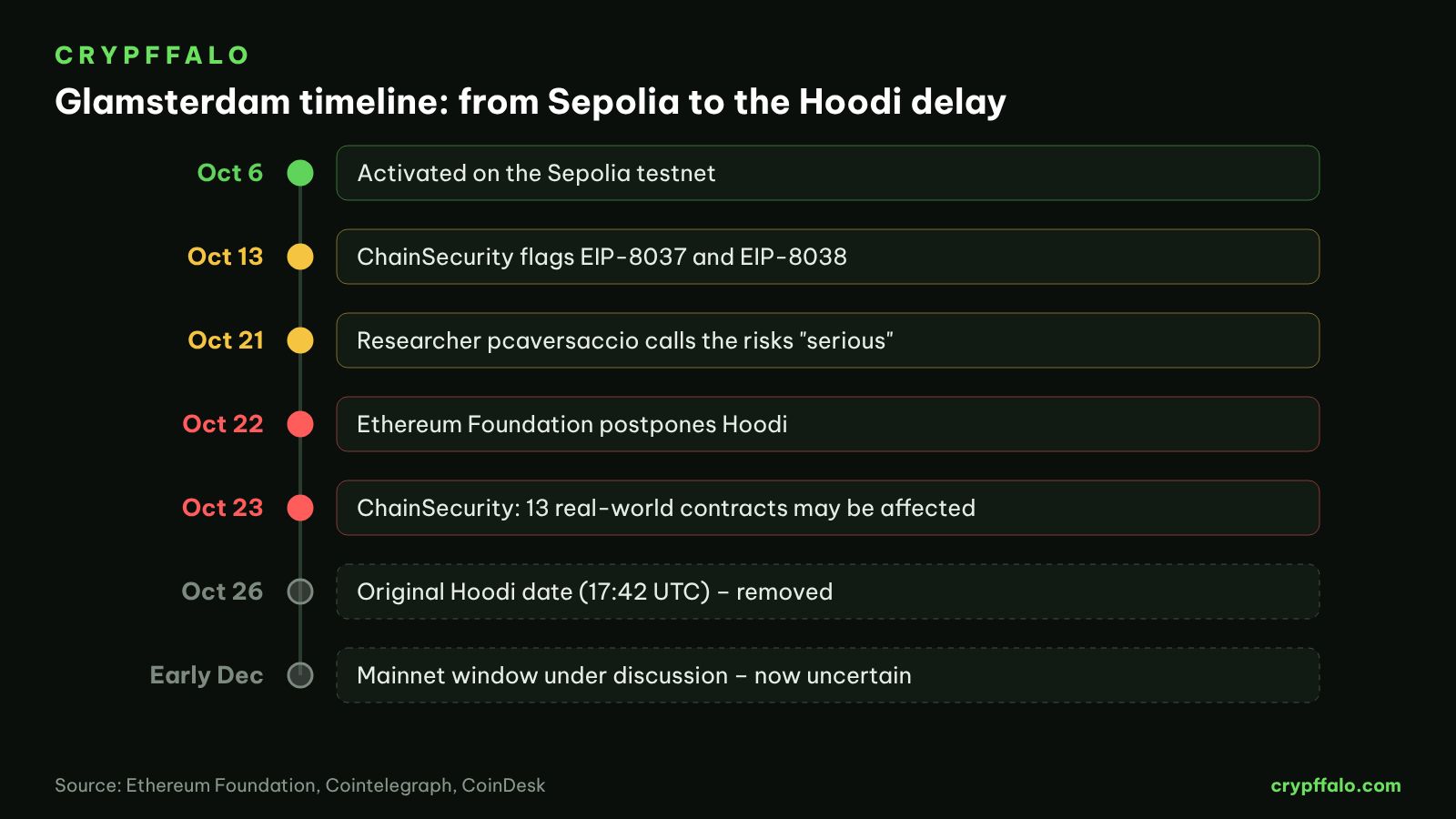
- Oct 6: Glamsterdam activated on the Sepolia testnet.
- Oct 13: ChainSecurity published its warning on EIP-8037 and EIP-8038.
- Oct 21: Security researcher pcaversaccio called the risks "serious" on GitHub and urged a reassessment of the fork.
- Oct 22: The EF removed the Hoodi schedule, including a planned gas limit increase to 200 million.
- Oct 23: ChainSecurity confirmed 13 real-world cases and began responsible disclosure.
The EF had earlier warned that Glamsterdam's gas model could break wallets, indexers and gas estimators built on fixed assumptions. Hoodi node operators now need to follow their client teams' updated instructions so they do not run the old schedule.
What it means for crypto markets
The price reaction has been muted, with ETH holding near $2,400 and bitcoin around $81,600. Traders remain more focused on ETF flows and the macro backdrop.
- Bull case: The flaw surfaced on a testnet rather than mainnet, showing the review process works; a clean fix could cost only a few weeks.
- Risk case: If the EIPs need a redesign or are dropped, Glamsterdam could slip into 2027, delaying scaling improvements many investors are waiting for.
Ethereum has pushed back upgrades for safety reasons before. For investors, the new Hoodi date is the clearest signal of when mainnet activation may follow.
What to watch next
- Upcoming All Core Devs calls: whether EIP-8037 and EIP-8038 are fixed, kept or removed.
- A new Hoodi activation date from the EF.
- Which projects are affected once ChainSecurity completes disclosure.
- Ether ETF flows and macro events on the economic calendar.
Frequently Asked Questions
Has Glamsterdam been cancelled?
No. Only a testnet step on Hoodi has been postponed; the upgrade already runs on Sepolia and never had a confirmed mainnet date.
Do ETH holders need to do anything?
According to the EF, mainnet users and ETH holders need take no action. Only Hoodi node and validator operators must update their software.
When will Glamsterdam reach mainnet?
There is no set date. An early-December window had been discussed, but it depends on a successful Hoodi test.
*This content is for information only and is not financial advice.*
Tags: Ethereum, Glamsterdam, Hard fork, Security
Related articles
- Binance targets Nov 1 withdrawal restart after finding more breach points in $6.3B hack
- Crypto stocks slide: Coinbase drops 12%, Strategy 11% as Binance hack weighs
- Binance sets aside $6.34 billion in corporate funds to cover hack losses
- Bitcoin Falls Below $77,000 as Binance Hack Triggers $1.5B in Liquidations
- Binance confirms $6.3 billion hack as analysts point to North Korea's Lazarus
- Binance Halts Withdrawals on Several Networks After Suspected Hack; CZ Expects Full Cover