DOJ seeks to seize $1.17 billion in USDC from Binance hack; Circle offers to reissue
Author: Crypffalo Research · 09:54 24/11/2026
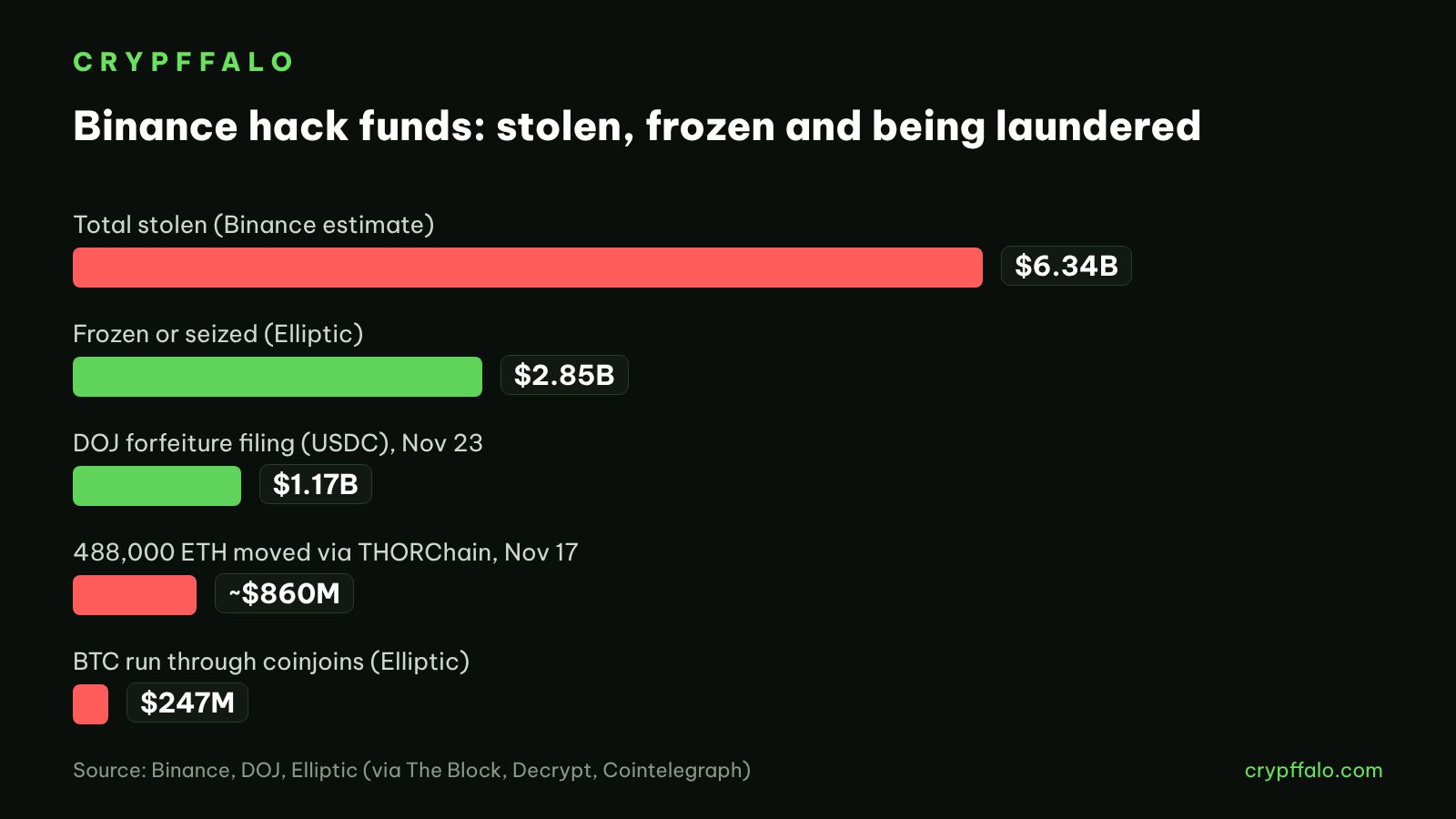
The U.S. Justice Department filed to forfeit about $1.17 billion in USDC tied to the $6.3 billion Binance hack, as Elliptic tracked at least $247 million in BTC pushed through coinjoin mixers.

The U.S. Department of Justice on Monday, Nov 23, filed a civil forfeiture complaint in federal court in Washington, D.C., seeking about $1.17 billion in USDC linked to the Oct 29 Binance hack. The funds sit across 36 addresses on 18 blockchains, including Ethereum, Solana, Polygon, Arbitrum and Base.
On the same day, blockchain analytics firm Elliptic said the hackers, which the FBI attributes to North Korea, have pushed at least $247 million in bitcoin through coinjoin mixers. The two developments show a race between investigators and the attackers more than three weeks after the roughly $6.3 billion theft.
Key takeaways
- Forfeiture: about $1.17 billion in USDC across 36 addresses on 18 chains, filed in D.C. federal court.
- Circle's role: Circle blocked the addresses and agreed to mint an equivalent amount of new USDC for the U.S. once a forfeiture order is issued.
- Laundering: Elliptic counts at least $247 million in BTC routed through coinjoins, mostly via one Wasabi Wallet coordinator.
- Attribution: the complaint names North Korea's Lazarus Group/APT38.
- Users: Binance says it has fully replenished the affected assets at its own expense.
What the DOJ complaint says
According to The Block and Bitcoin.com, the filing follows a Nov 12 temporary restraining order, when the DOJ said it had court authorization to seize or restrain more than $1.2 billion. Prosecutors also asked the judge to keep the assets restrained so there is "no lapse" if the earlier order expires.
The recovery mechanism is the notable part. Circle told prosecutors it cannot move the original tokens because the wallets remain under attacker control, so it will issue new USDC in an equivalent amount and transfer it to the U.S. upon a forfeiture order.
Per the complaint as cited by Bitcoin.com, a Binance employee was approached by a fake recruiter and told to install malware-laced software during a job interview. The attackers then allegedly abused Ethereum's EIP-7702 to manipulate wallet authorizations and used automated sweeper contracts to grab assets on arrival.
- Oct 29: the hack; $780 million in USDC moved at 20:41 UTC, followed by $43 million 18 minutes later.
- Nov 12: DOJ obtains a temporary restraining order covering more than $1.2 billion.
- Nov 17: about 488,000 ETH (roughly $860 million) leaves theft-linked wallets and is swapped to BTC via THORChain.
- Nov 23: DOJ files to forfeit $1.17 billion; Elliptic updates its tally to $247 million through coinjoins.
How the hackers are laundering funds
Elliptic said the ETH moved on Nov 17 was quickly converted to BTC and sent into coinjoins, often within hours. Nearly all of the mixing was coordinated by a single operator, Kruw, which Elliptic says does not block funds like these.
Elliptic estimates about $2.85 billion of the stolen funds has been frozen or seized. The 18,270 BTC taken directly from Binance has not moved since the attack, and the firm expects the hackers to keep converting to BTC, mixing and cashing out through OTC brokers over the coming months.
Crypffalo data view
Crypffalo's DeepDom data for the 24 hours to 9:00 GMT+7 on Nov 24 shows the market barely reacted to the legal news:
- Price: BTC near $61,067, up 0.37%; ETH near $1,705, down 0.29% → prices were flat.
- Liquidations: BTC saw $52.7 million in longs and $95.1 million in shorts liquidated; ETH $34.4 million longs and $58.8 million shorts → shorts took more of the pain.
- Aggressive flows: BTC futures net buying of about $1.02 billion while BTC spot was roughly balanced (net selling of about $1 million); ETH net buying of $190.1 million on futures and $19.4 million on spot → buyers dominated futures.
- Order book ±1%: BTC had $139 million in bids versus $151 million in asks; ETH was balanced ($62.3 million vs. $61.9 million) → BTC leaned slightly to the sell side.
The data fits the view that the forfeiture filing is a follow-up to the hack rather than a new source of selling pressure. You can also track real-time liquidations.
What it means for crypto markets
Bitcoin is holding around $61,000 after rebounding from the $55,100 low, suggesting the news matters more for the security and stablecoin narrative than for short-term price action.
- Bull case: if the court approves and Circle's reissue goes through, it sets a precedent that centralized stablecoins can help recover stolen funds at scale, supporting confidence in USDC and large exchanges.
- Risk case: roughly $2.22 billion to $2.35 billion (depending on Elliptic's estimate) still sits in theft-linked wallets; continued conversion to BTC and OTC sales could add scattered supply and push regulators to tighten rules on mixers and cross-chain bridges.
The "freeze and reissue" model also revives a familiar debate: centralized control lets issuers claw back stolen funds quickly, but it reminds holders that tokens can be blocked at any time.
What to watch next
- The court's ruling on the renewed restraint and on a final forfeiture order.
- When Circle mints replacement USDC and transfers it to the U.S. government.
- Whether the 18,270 untouched BTC starts moving, and flows through THORChain and coinjoins.
- This week's macro events on the economic calendar.
Frequently Asked Questions
Did Binance users lose money?
Binance says it fully replenished the affected assets at its own expense, so customers did not bear direct losses from the hack.
Why is Circle minting new USDC instead of moving the old tokens?
The wallets holding the USDC are still controlled by the hackers, so Circle can only block them and issue an equivalent amount to the U.S. once a forfeiture order is granted.
Does the U.S. government already own the $1.17 billion?
Not yet; the forfeiture still needs court approval, and for now the assets are only restrained.
*This content is for information only and is not financial advice.*
Tags: Binance, Hack, USDC, Circle, DOJ
Related articles
- BTC Long/Short Ratio by Exchange: Binance, OKX, Bybit, Hyperliquid
- Bitcoin ETFs bleed $570M for fifth straight day as BTC slips to $60,600
- Nvidia reinstates Jensen Huang as CEO, shares jump 29%; Bitcoin hits $63,800
- Strategy buys 457 BTC for $29.6M, spends $211.8M on STRC preferred buybacks
- Bitcoin briefly hits $17K on Kraken's CAD market as exchange says trades stand
- Chainflip confirms $12 million hack, offers attacker 10% bounty to return funds